
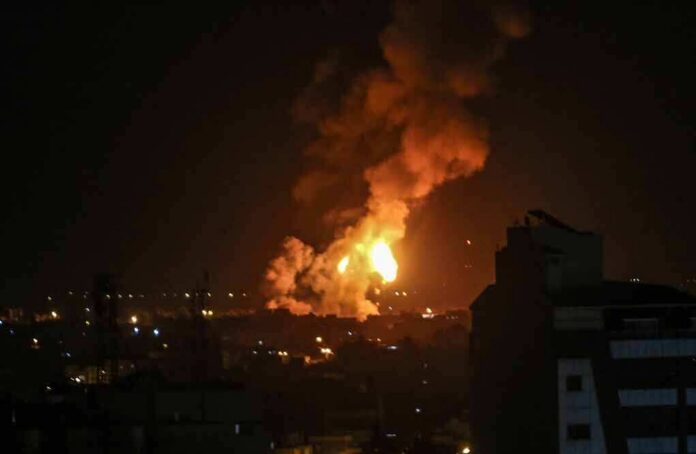
A towering fireball over central Israel has reignited doubts about official narratives, reminding Americans why blind trust in government—any government—is a dangerous habit.
Story Snapshot
- A massive late-night blast near Jerusalem lit up the sky and rattled residents across central Israel.
- Israel’s state-owned defense firm Tomer says it was a “pre-planned experiment” and not an attack.
- Dramatic mushroom-cloud visuals and zero public warning are fueling global skepticism and conspiracy chatter.
- The information fog offers a warning for U.S. citizens about transparency, defense secrecy, and constitutional oversight.
What Actually Happened Over Beit Shemesh
Residents near the Israeli city of Beit Shemesh, west of Jerusalem, were jolted by a massive nighttime explosion that produced a giant fireball and what many described as a mushroom-cloud-like plume visible across multiple communities.[1] Videos flooded social media within minutes, showing a bright flash, soaring flames, and thick smoke towering into the night sky.[2] People on the ground reported hearing a huge blast, feeling shockwaves, and initially fearing a missile strike or something nuclear in scale.[2][3]
Israel quickly identified the site as a facility operated by Tomer, a state-owned defense company that develops rocket and missile engines, including systems tied to the Arrow air and missile defense network.[1] The sensitive location, linked in open reporting to Israel’s strategic missile infrastructure, immediately raised alarm about whether a key defense asset had been hit or compromised. With tensions already high in the region, the sheer scale of the explosion amplified those fears in Israel and abroad.[3]
The Official Story: A “Pre-Planned Experiment”
Tomer issued a statement saying the blast was not an attack but a “pre-planned experiment that was carried out according to plan,” language echoed in liveblog updates from Israeli media.[1] Company sources told a public broadcaster that the explosion was part of routine testing conducted at all hours, including night, for operational needs.[1] These sources also claimed police, the Israel Defense Forces, and Fire and Rescue services were notified in advance, which they said explained the absence of emergency vehicles rushing to the scene.[1]
Israeli officials further stated there were no injuries and no external damage reported from the event, reinforcing their argument that this was a controlled test and not a wartime incident gone wrong. The Defense Ministry reportedly treated the incident as an authorized experiment, saying only that the issue of advance warning to the public would be reviewed with the company, suggesting bureaucracy, not battlefield chaos, was at play.[1] Authorities have consistently denied any security breach, attack, or sabotage linked to the explosion.[1]
Why So Many People Do Not Buy the Explanation
Despite the unified official line, skepticism has surged inside and outside Israel, driven less by hard evidence and more by visuals, timing, and the site’s strategic role.[2] Commentators and video outlets repeatedly juxtaposed the stunning mushroom cloud with terms like “nuclear-linked site,” “secret base,” and “hidden strike,” even while conceding there is no proof of a nuclear detonation or confirmed foreign attack.[2][3] The lack of public warning, especially late on a Sabbath night, has been cited as a major reason residents felt blindsided and suspicious.[1]
Some Hebrew and international outlets have floated unverified scenarios ranging from an accident in a sodium-perchlorate propellant storage area to a catastrophic loss of Arrow interceptor stockpiles, but none of that is backed by primary technical documentation in the available record.[3] What is documented is that no independent forensic report, crater analysis, or intercepted communication has surfaced showing sabotage or a foreign strike.[1][2] The controversy therefore lives in an information gray zone: a thin official explanation versus a noisy ecosystem of speculation, with neither side yet presenting decisive public proof.
Lessons for American Patriots Watching From Afar
For Americans who have watched years of opaque decisions from our own security bureaucracy, the Beit Shemesh blast is a case study in why transparency and constitutional oversight matter.[1][2] A government-coordinated narrative, backed by a state-owned weapons manufacturer and the national defense establishment, can quickly become the “only” story the public is allowed to see, even when key details—like test parameters, safety plans, and notification logs—remain hidden from ordinary citizens.[1] That pattern should concern anyone who values limited government and accountability.
Powerful Explosion Reported at Defense Facility in Beit Shemesh, Israel#Israel #Explosion #BreakingNews #MiddleEast #DefenseNews #WorldNews #IsraelNews #FlashNews24https://t.co/rIuFkfzM9t
— FLASHNews24 (@ebcnewss) May 17, 2026
Under President Trump’s second term, conservatives have pushed to restore trust by demanding that America’s own Pentagon, intelligence community, and defense contractors answer to the people, not the other way around. Incidents like this overseas underscore why that fight matters. When a massive explosion can be brushed off with a two-line statement and no supporting data, it reminds us that without rigorous oversight, bureaucrats anywhere will default to secrecy, leaving citizens—Israeli or American—sorting truth from rumor in the dark.[1][2]
Sources:
[1] Web – Late-night blast, fireball near Beit Shemesh rattles jittery …
[2] YouTube – Giant Smoke Plume Rises After Explosion at Nuclear- …
[3] YouTube – Massive Explosion Hits Israel’s ‘Nuclear, Missile Hub’; …