

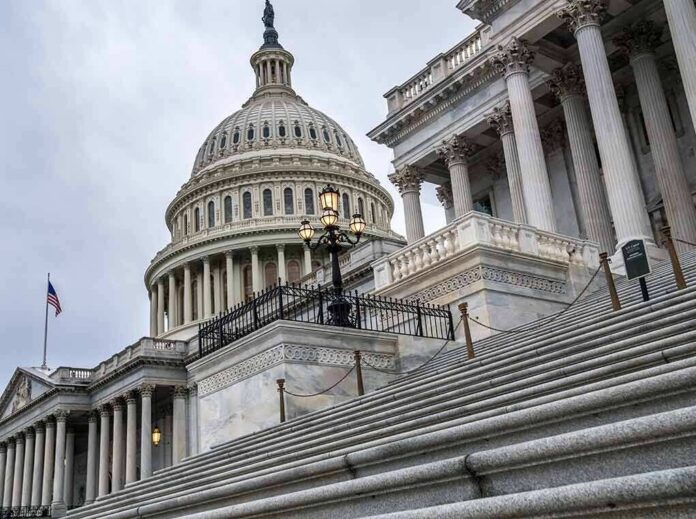
Nine Senate contests and roughly four dozen House races could decide who controls Congress in 2026, concentrating power in a small map that both parties are racing to dominate.
Story Highlights
- CBS News flags nine Senate and 42 House races as likely to decide control.
- Named Senate battles include Alaska and Maine with specific contenders.
- All 435 House seats are on the ballot; 218 seats are needed for a majority.
- Independent reporting tracks a similar map, with about 50 competitive House races.
What’s on the line: Control of Congress will come down to a narrow map
CBS News identifies nine Senate and 42 House races as the contests most likely to decide control of Congress this fall, underscoring how a few states and districts will shape national policy for years. That tight set matches a common pattern in modern elections, where only a sliver of seats are truly competitive. Reuters also reports that about nine Senate races and roughly 50 House races could determine control, showing broad agreement on the tight battlefield.
All 435 House seats are on the ballot in November, and the majority threshold is 218 seats, with two vacancies currently on the board. That math means a handful of swing districts can flip the gavel. CBS points to a newly redrawn Southern California seat where Republican Jim Desmond and Democrat Marni Von Wilpert are running to replace retiring Representative Darrell Issa, a sign that map changes can reshape competition late in the cycle.
Key Senate contests: Alaska, Maine, and a small set of true tossups
CBS singles out specific Senate races, including Alaska, where Republican Senator Dan Sullivan faces former Democratic Representative Mary Peltola, and Maine, where Republican Senator Susan Collins faces Democrat Troy Jackson after a summer nominee change. These named matchups give voters a concrete look at where control could flip. Reuters reports Democrats likely need four seats to win the 100-seat chamber, which puts pressure on every true tossup that lands inside that small group.
These Senate races will likely draw heavy national money and ground teams because each seat could tip the chamber. Late changes, like candidate swaps or new disclosures, can still shift the board, and CBS notes at least one late substitution in Maine this summer. That fluidity is normal in the final stretch, but it does not change the central fact: the map is narrow, the stakes are high, and the margins will be thin.
House battlefield: Redrawn lines and a shrinking number of swing seats
CBS reports that a few dozen House contests will likely decide control, even though every seat is up for election. That is in line with independent tracking that expects about 50 competitive House races nationwide. One highlighted race sits in a newly redrawn Southern California district, where both parties see a real shot. Those map shifts matter because new lines can scramble coalitions, alter turnout paths, and move local issues into the national fight.
🗳️ CONGRESSIONAL ELECTION WATCH
September 12, 2026SECTION 1 — TOP DEVELOPMENTS
• MISSOURI REDISTRICTING — Missouri will use its 2022 congressional map for the November election after the Supreme Court blocked use of the newly drawn map. The decision creates significant…
— Warren W. (@warrenwhite123) September 12, 2026
Conservative voters should see the core reality: control of Congress will be set by a compact list of districts and states. That means targeted engagement can have an outsized impact. Door knocks, small-dollar giving, and local turnout operations in these places can check big-city agendas, defend border security, protect energy independence, and guard the right to keep and bear arms. When only a few races decide national power, every call, visit, and vote in those areas counts more than ever.