

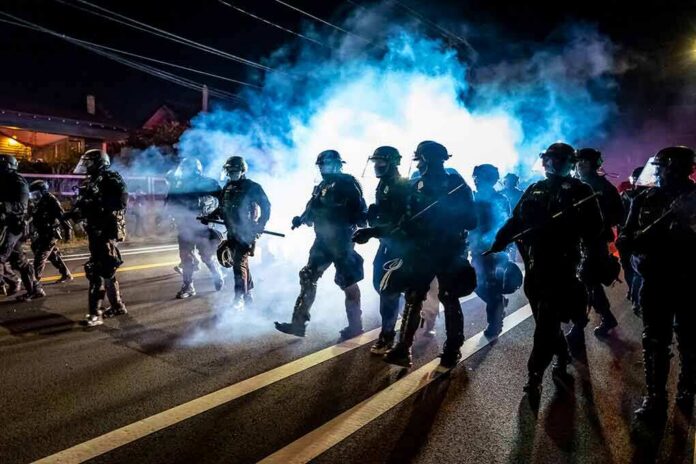
Paris shopkeepers are boarding up the Champs-Élysées as France floods the streets with tens of thousands of security forces ahead of another protest weekend.
Story Highlights
- Shops near recent flashpoints in Paris have boarded up ahead of planned protests.
- France has deployed tens of thousands of police and gendarmes after prior riots.
- Police cleared central gathering areas during security operations in Paris.
- Earlier unrest brought arson, looting, and hundreds of arrests across France.
Shops Fortify Near Recent Flashpoints
BBC live coverage reported boarded storefronts around Place de la République, a recent protest hotspot tied to earlier clashes and damage. Business owners responded to warnings about new unrest by securing windows and doors. Local images showed plywood shields and metal shutters ready for impact. Owners described tough choices between safety and staying open. The response followed reports of ransacked shops and burned cars during prior unrest, which left many merchants wary of renewed violence.
Authorities also focused on areas that drew spontaneous crowds in past nights. Shops near central squares and major avenues prepared for quick closures if demonstrations shifted. The protective steps reflected worry about fast-moving groups that target high-visibility sites. The goal was to reduce smash-and-grab risk and protect workers. Some stores planned limited hours and smaller staffs. Others stacked goods away from front windows to cut losses if windows shattered during any clashes.
Massive Security Presence After Riots
Reuters reported that Interior Minister Gérald Darmanin ordered 45,000 police after three straight nights of riots, calling the coming hours decisive. The Associated Press reported separate plans for 70,000 officers ahead of another weekend, underscoring how deployments scaled with risk assessments and timing. The different figures reflect distinct moments and scopes, not a single tally. Leaders aimed to deter arson, looting, and assaults that had strained services and threatened daily life during earlier outbreaks.
Police tactics included mobile units, helicopters, water cannons, and armored vehicles to protect public buildings, according to the Associated Press. Euronews reported that soldiers from the Operation Sentinelle mission would guard fixed sites, freeing police and gendarmes for crowd control and public order tasks. That approach sought to keep rapid-response teams flexible while maintaining security at museums, train stations, and government offices. The plan prioritized speed, clear routes for ambulances, and quick dispersal of unlawful violence.
Central Squares Cleared To Prevent Flash Mobs
Reuters reported police cleared crowds from Place de la Concorde after an impromptu gathering formed there. Officers acted to block quick surges that had led to vandalism and fires during prior nights. Clearing high-profile squares reduced the chance of spillover into nearby shopping streets. It also aimed to prevent groups from using those spaces as staging grounds for marches that could overwhelm local police lines.
France 🇫🇷 is bracing for the second round of protests. French authorities deployed 70,000 police and gendarmes countrywide, including elite units like BRI, RAID, and GIGN plus armored vehicles, amid route disputes in Paris and fears of renewed unrest.
Initially, the media…
— TheLogicalOne 🇺🇸 (@Logicalone) October 24, 2026
National coverage documented earlier nights of arson, smashed storefronts, and mass arrests, which shaped the current risk posture. Those facts informed closures and route limits as officials balanced safety with the right to assemble. French law expects demonstrations to be declared with authorities in advance, and restrictions are supposed to be specific and proportionate. Live reports this week again showed the familiar cycle: unrest, emergency deployments, and then fortified city centers to shield people and property.
Why This Matters To American Readers
Scenes of boarded shops on a famous Paris avenue are not only a French story. They show what happens when order breaks down and leaders fail to protect small businesses. Police surged only after fires and theft hit neighborhoods and landmarks. Many family-owned stores cannot absorb hit after hit. When public order collapses, criminals exploit chaos. That truth crosses borders. It is a reminder that strong, accountable policing protects workers, families, and the right to speak without fear.
Government must defend both safety and lawful assembly. That balance requires clear rules, firm enforcement against violence, and swift help for victims. France’s plan used heavy deployments, fixed-site guards, and fast-clearing tactics to stop repeat damage. The facts show why deterrence matters: prior nights brought torched cars and ransacked shops. As Paris braces again, boarded windows tell a hard lesson. If leaders hesitate, regular people pay the price first and longest.
Sources:
facebook.com, bbc.co.uk, euronews.com, cbsnews.com