

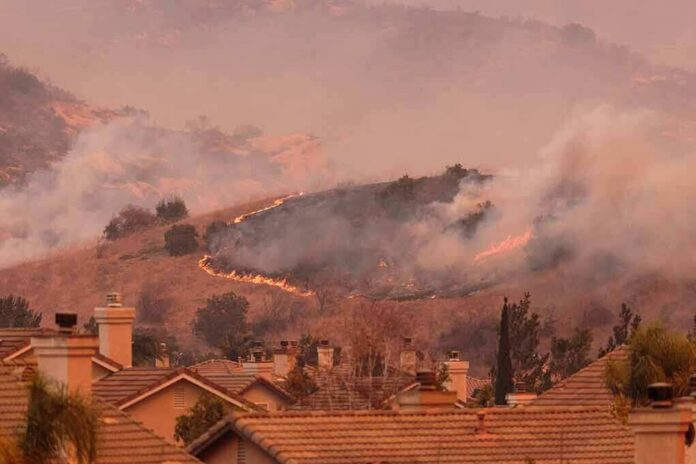
A 724-page state investigation found delayed evacuations and poor coordination turned the Palisades fire into a preventable tragedy.
Story Highlights
- Independent review found sweeping failures in alerts, coordination, and planning.
- Some residents got evacuation warnings after homes had already started burning.
- Los Angeles Fire Department ignored repeated warnings a prior blaze was still smoldering.
- Officials say an empty reservoir was documented but not the key cause of losses.
State Probe Documents Delayed Warnings As Fire Advanced
State investigators said evacuation alerts reached many people far too late, even after homes had begun to burn. Reporting on the findings says some residents received warnings 40 to 90 minutes after flames reached structures, a gap no family should face in a fast-moving fire. The review describes “sweeping deficiencies” that slowed alerts and confused command chains across agencies. The bottom line is simple and chilling: warning systems that should protect families did not work when it mattered most.
Investigators said outdated procedures and a messy software transition forced manual map work during evacuations, adding minutes as winds pushed flames toward neighborhoods. The review points to inconsistent policies that made it harder to coordinate between city and county teams, lengthening the time needed to draw zones and press send. For people on narrow streets with one exit, those minutes were everything. Systems exist to save lives; when they lag, they cost them. That failure demands real fixes now.
LAFD Missteps Before And During The Blaze
The report says the Los Angeles Fire Department did not act on repeated warnings that the Jan. 1 Lachman fire was still smoldering before winds returned. Days later, that hot spot flared into the deadly Palisades fire, according to coverage of the investigation. The department also struggled to track its own crews and work in step with the Los Angeles Police Department during evacuations. These are not weather problems. These are command-and-control problems that better leadership and training can solve.
County materials echo that there was no “single point of failure,” but they still list policy gaps, inconsistent practices, and weak communications as key weaknesses. That framing matters. It reinforces that people on the ground worked hard in extreme conditions, yet leadership systems did not hold up. Conservatives know this pattern: big-city bureaucracies pile up rules, then fail on the basics. Clear authority, real accountability, and hands-on drills beat glossy plans every time when lives are on the line.
Empty Reservoir Was Real, But Not The Decisive Factor
The Santa Ynez Reservoir, which can hold 117 million gallons, was empty for repairs when the fire ignited, and that fact is part of the official record. State water analysts concluded the system still had robust supply and that a full reservoir likely would not have changed the outcome, based on their engineering review. That does not erase the fear residents felt when hydrants sputtered. It does mean the central fixes lie in command, alerts, and staging, not just a single tank.
City leaders say some reforms are already underway, including stronger interagency coordination and better pre-deployment steps before red-flag wind events. Those steps align with investigators’ calls to confirm fires are fully out, to track every unit in real time, and to plan evacuations with simple, tested tools. The measures are common sense. Families deserve them before the next wind event, not after another after-action report. President Trump’s team has pressed for accountability across agencies. California must do the same at home.
What Must Change Before The Next Santa Ana Wind
Officials need a minute-by-minute alert playbook that any trained operator can run at 2 a.m. Maps must be ready, zones must be pre-built, and messages must be plain and fast. Incident command must be unified, with police and fire sharing one set of goals, radios, and trackers. Crews must verify every hot spot is cold before winds return, with written sign-offs and patrol logs. These steps respect taxpayers, save lives, and uphold the first duty of government: protect the public without excuses.
Sources:
facebook.com, latimes.com, abc7.com, nypost.com, ground.news, westsidecurrent.com, us.headtopics.com, dailynews.com, cbsnews.com