
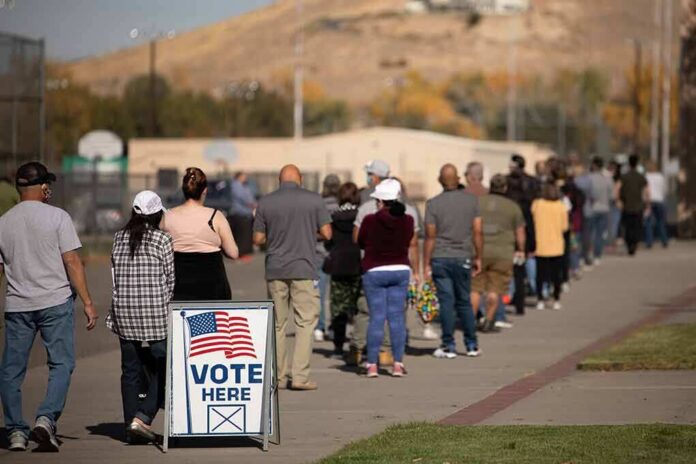
A nationwide “No Kings” push told attendees to vote early at the protests themselves, turning rallies into on-the-spot election activity.
Story Snapshot
- Organizers urged early voting and absentee ballots as a central protest action.
- Hundreds of partner groups, including the American Civil Liberties Union, backed voter-focused activities.
- Reports cited thousands of planned events across all 50 states, with varied local turnout.
- Some events offered registration tables and voting-rights information alongside anti-Trump themes.
Organizers Tie Protests Directly to Early Voting
Organizers made early voting the core action for October 17 events. The New York Times reported that the coalition urged participants to vote at early-voting sites or return an absentee ballot the same day. Public messaging framed early voting as the way to use political power. This turned rallies into get-out-the-vote drives. The approach moved beyond slogans and asked people to take a concrete step that could shape the 2026 midterms.
Outlets also described specific voter tasks promoted on-site. Oregon Public Broadcasting reported that events helped people check registration, make a voting plan, and learn their voting rights. That list reflects standard voter-contact best practices. It matches what many civic groups do in the final weeks before an election. By pairing protest energy with simple steps, organizers tried to convert attention into ballots, not just headlines.
Scope: Thousands of Planned Events, Uneven Local Crowds
Reports cited thousands of planned events with a coast-to-coast footprint. The New York Times mentioned more than 2,500 and, elsewhere, more than 3,000 events; ABC7NY cited more than 2,000 in all 50 states. Local attendance varied by city. PBS said a Washington gathering “appeared” to be a few hundred. The Los Angeles Times reported several hundred at one park and about 500 in Temecula. NPR noted thousands in Minneapolis and about 200 in Baton Rouge.
The coalition behind the effort featured a large progressive network. The New York Times described about 200 organizations, including the American Civil Liberties Union and the League of Women Voters. Oregon Public Broadcasting also listed American Civil Liberties Union and Black Voters Matter among hundreds of partners. That base gave the campaign reach, volunteers, and materials. It also linked the day’s push with groups that often oppose President Trump’s policies, shaping how many Americans understood the message.
On-Site Voter Services and Messaging Against Trump
Several events offered direct voter services. ABC7NY reported that the Manhattan event featured speakers and voter registration. NPR described tables with voting information and ways to “protect the election” set up before a march. These activities suggest an effort to move beyond signs and speeches. People could leave with a registration update, a ballot plan, or information on how to respond to a problem at the polls, all within the same protest footprint.
Coverage also showed broader themes alongside voting. PBS described the network as opposed to President Trump and linked the day to almost two years of demonstrations. The Los Angeles Times reported that some California rallies focused on federal immigration enforcement as well as voting. Mixing messages can pull larger crowds, but it can also blur the core turnout goal. For conservative readers, this shows how political activism often wraps electioneering into protest theater.
What We Know, What We Do Not
The reporting establishes concrete voter-engagement steps and large planned scope. It also shows real, if varied, local participation. Common Dreams reported that nationwide attendance totals were not available, despite the high event count. Researchers have found that protests sometimes raise turnout by small margins, but effects often depend on location, audience, and follow-up contact, not just rally size. The October 17 actions fit that pattern: strong intent, measurable activity on-site, and impact to be seen.
🚨🇺🇸 “NO KINGS” PROTESTS IN BOSTON
Protesters rallied against Trump, denouncing authoritarianism and urging voters to turn out for November’s midterm elections. pic.twitter.com/JYC8CORUlX
— GFN (@GFNIND) October 18, 2026
Political implications are clear. Turning protests into early votes can matter in close races. The coalition’s message asked people to act now, not later. For those who value election integrity and equal rules for all, close attention to how groups run on-site voting help is warranted. The facts show robust organizing and direct services. The open question for campaigns is simple: did those steps move real ballots into the box, and where will they matter most?
Sources:
nytimes.com, commondreams.org, pbs.org, abc7ny.com, latimes.com, opb.org, circle.tufts.edu