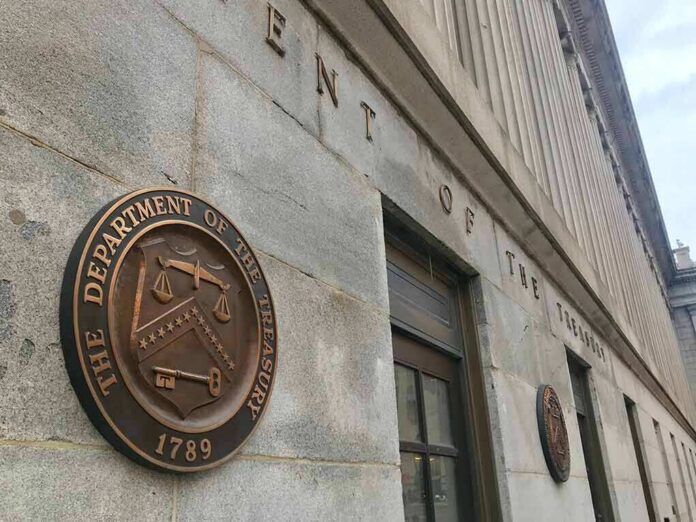
The U.S. Treasury cut off a Turkey-based bank it says moved tens of millions for Iran’s Revolutionary Guard, striking a key terror finance pipeline.
Story Highlights
- Treasury sanctioned Golden Global Bank for facilitating funds for Iran’s Islamic Revolutionary Guard Corps-Qods Force.
- Officials said the bank gave critical correspondent access that helped move oil money across borders.
- The action falls under Executive Order 13902 and continues a wider clampdown on Iran-linked shadow banking.
- The bank denied wrongdoing and said it follows all laws, but offered no specific rebuttal.
Treasury Moves To Block Alleged IRGC Funding Channel
The U.S. Department of the Treasury announced sanctions on Golden Global Yatirim Bankasi, known as Golden Global Bank, based in Istanbul. Treasury said the bank and related entities helped the Islamic Revolutionary Guard Corps-Qods Force move tens of millions of dollars, including oil revenue, through Turkey. Officials said the bank provided key correspondent banking access that enabled cross-border transfers tied to Iran’s network. The Office of Foreign Assets Control made the designations under the Iran sanctions program as part of Operation Economic Outcast.
Treasury linked the action to authorities under Executive Order 13902, which targets sectors of Iran’s economy that fund terrorism and military programs. Press materials named the bank’s location and international transfer identifiers, underscoring the compliance risk for any institution still dealing with it. Recent actions track a clear pattern: go after the money handlers, close their paths to the dollar, and freeze assets to raise Iran’s costs. Treasury has used this model against dozens of Iran-linked financiers since 2025.
Why This Sanction Matters For U.S. Security
Iran’s Islamic Revolutionary Guard Corps-Qods Force is a U.S.-designated terrorist arm that runs proxy warfare and covert finance. When a foreign bank gives that network a route to move cash, it can fuel missiles, drones, and attacks on allies. Cutting that route protects American troops, partners like Israel, and shipping lanes. It also signals that under President Trump, the United States will not let overseas middlemen weaken our sanctions with clever paperwork or shell companies.
Past campaigns show that sanctions bite hardest when they hit the middle links: traders, front firms, brokers, and small banks that stitch together the payments. Treasury has repeatedly warned that anyone who “knowingly” supports significant transactions for sanctioned entities can face penalties. That includes foreign firms with no U.S. office if they touch the U.S. financial system or need access to the dollar. Today’s move fits that tested playbook and aims to shut doors fast, before funds are dispersed.
What The Bank Says, And How Strong The Record Looks
Golden Global Bank denied wrongdoing through press statements. The bank claimed it follows local and international banking rules, and said named people and entities are not customers. It also said it plans to pursue legal options against “unfounded” claims. These are blanket denials without specific evidence presented in public so far. Reuters reported the denial, but the U.S. Treasury’s documents outline the basis for the designations and the alleged role the bank played in transfers.
Sanctions are not criminal convictions, but they carry real legal force. The Office of Foreign Assets Control designations block any property in the United States and restrict dealings by U.S. persons. They also raise major risk for non-U.S. banks that might consider processing related payments. When Treasury lists a financial institution with its identifiers, markets listen. That is why correspondent partners often exit fast. The burden then shifts to the sanctioned party to petition for removal with proof.
Broader Crackdown On Iran’s Shadow Banking
The U.S. government has focused on Iran’s “shadow banking” web, which hides oil money behind cut-outs and pass-through accounts. In recent years, Treasury has sanctioned large networks that supported the Islamic Revolutionary Guard Corps and Iran’s defense ministry. Executive Order 13902, first signed in 2020, enables pressure on Iran’s financial and petroleum sectors that feed its missile and terror activity. This latest action continues that approach and targets new routes that opened through third countries.
🚨 Yesterday, the US Treasury Department announced sanctions against the Turkish bank Golden Global Bank and its affiliates, as part of an "economic isolation" operation against Iran. The sanctions were imposed because the bank helped transfer tens of millions of dollars for the… pic.twitter.com/lIhyOndlSi
— Raylan Givens (@JewishWarrior13) September 6, 2026
For American readers, the bottom line is simple. Terror groups need money. Banks that knowingly open doors for them put our people at risk. President Trump’s administration is using lawful tools to shut those doors, defend our allies, and keep U.S. service members safer. If a bank wants access to the dollar, it must keep clean books and stop helping rogue regimes. That is common sense, strong policy, and a win for American security and rule of law.
Sources:
zerohedge.com, cryptobriefing.com, bloomberg.com, ofac.treasury.gov, home.treasury.gov, nampa.org, open.metu.edu.tr