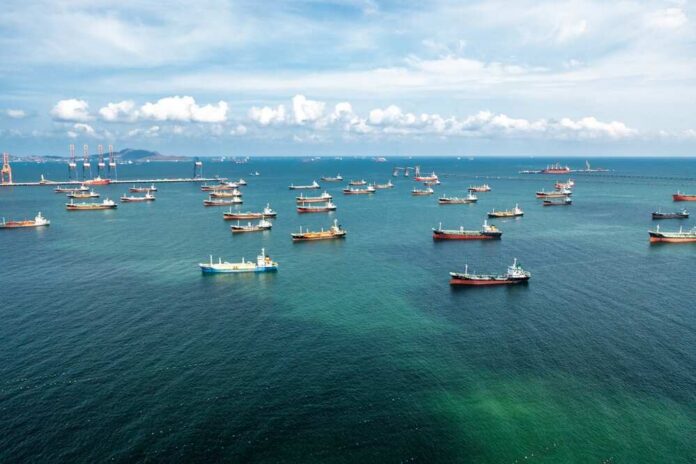
Ships are finally moving through the Strait of Hormuz, but the evacuation still looks controlled, fragile, and far from normal.
Quick Take
- The International Maritime Organization has started a plan to move about 11,000 stranded seafarers and hundreds of vessels through Hormuz.
- Officials say ships are sailing under safety guarantees, but the route still depends on temporary controls.
- Oman says the standard navigation scheme remains unsafe, which means the waterway is not back to normal.
- Transit data is still messy, with ship-count estimates that do not fully match.
Evacuation Plan Gets Under Way
The International Maritime Organization says it has begun a large-scale evacuation in the Strait of Hormuz. The plan is meant to move roughly 11,000 stranded seafarers and hundreds of ships through the waterway after weeks of conflict and disruption. Reports say a few vessels have already passed under the new framework, while many others are still waiting for instructions.
The key point is simple: this is progress, but not a full return to free passage. The organization says the operation is being carried out with Iran, Oman, the United States, and other coastal states. It also says safety guarantees have been secured. But the fact that vessels are being managed through a special plan shows how unusual the situation still is.
Why the Route Still Is Not Normal
The Strait of Hormuz remains under heavy control because officials still see real risks. The International Maritime Organization said the long-standing Traffic Separation Scheme was only usable once conditions improved, and Oman’s Defence Ministry said the standard scheme was still unsafe. That is why ships are being routed through temporary paths instead of simply sailing as they please.
This matters because the details show an emergency corridor, not a restored sea lane. The public can hear words like “safe passage” and assume the crisis is over. The facts point to something narrower. Ships are moving in a phased way, and the remaining traffic is being handled with instructions, timing rules, and monitoring meant to prevent collisions.
Numbers Show A Partial Opening
The traffic counts tell the same story. One report said 36 commercial ships crossed the strait on Monday, the highest level since the fighting began. Other tracking data cited by reports showed at least three vessels moving through in a short window, with more ships lining up behind them. That is a sign of reopening, but it is still far below normal traffic.
There is also a wide gap in the reported numbers. The International Maritime Organization has described around 30 ships a day moving through the strait, while United States Central Command has at times put the figure closer to 55. That kind of mismatch invites doubt and shows why readers should be cautious about any claim that the crisis is fully resolved.
Politics Around The Corridor Remain Tense
Iran has pushed back on the corridor idea and has argued that the proposal is legally weak and politically driven. At the same time, other reports say Iranian officials have kept a close hand on vessel movement and inspections. That leaves the region in a delicate spot, where even a humanitarian-style shipping corridor still depends on political deals and security rules.
🔴 Oman and IMO activate evacuation corridor for 100s of ships trapped in Strait of Hormuz
Oman and the International Maritime Organization issued coordinated guidance Wednesday for vessels stranded since Iran closed the Strait of Hormuz on February 28 following U.S. and Israeli… pic.twitter.com/blX0K4zKZQ
— NewsTongue (@NewsTongueX) June 24, 2026
For Americans watching from afar, the lesson is obvious. Global bodies can announce stability, but real stability means open navigation without emergency choreography. As long as mines, inspections, special routes, and disputed ship counts remain in the picture, the Strait of Hormuz is not back to normal. It is only being managed through a temporary truce that could still break under pressure.
Sources:
[1] Web – Hormuz Exodus Begins: Ships Finally Sailing As UN-Led Evacuation …
[2] Web – UN starts evacuating 11000 stranded sailors from Strait of …
[3] Web – UN begins phased evacuation of ships from Gulf
[4] Web – Ships begin sailing through Strait of Hormuz under UN
[5] Web – The UN’s maritime agency has launched an operation to …
[6] Web – Ships Resume Transit Through Strait of Hormuz Under UN- …
[8] Web – The #UN’s maritime agency has launched an operation to …
[9] Web – A Temporary Corridor Strategy for Hormuz
[10] Web – The Closure of the Strait of Hormuz by Iran: Considerations …
[11] Web – The Strait of Hormuz, shipping, and law
[12] Web – Iran Rejects IMO Proposal for Safe Maritime Corridor
[13] Web – Trump: Iran has assured us that it will not impose transit …
[14] Web – CNN
[15] Web – Immediately Restore Freedom of Navigation through Strait of …
[17] YouTube – Safety and Protection of Waterways in the Maritime Domain …
[18] Web – Considerations for Planning Mass Evacuations of Civilians in …
[19] Web – Warnings in Contemporary Conflict: Protective Measure or …
[20] Web – How humanitarian corridors work to help people in conflict …
[21] Web – AnewZ
[22] Web – UN / MARITIME SECURITY | UNifeed – UN Media
[23] Web – maritime transportation research and education center