

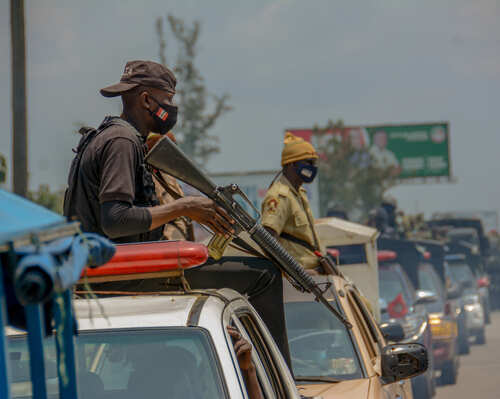
Nigeria’s ambitious counter-terrorism strategy launches in 2025 while ISIS affiliates expand territorial control across West Africa, creating a dangerous paradox that threatens American interests in global security.
Story Overview
- Nigeria launched its Strategic Plan 2025–2030 amid expanding ISIS affiliate territorial control
- Over two million people displaced as terrorist organizations consolidate operations across the Sahel
- Western military withdrawal creates security vacuum while Russia expands regional influence
- UN warns vast territory from Mali to northern Nigeria could fall under ISIS control
Nigeria Steps Up While ISIS Expands Operations
Nigeria’s National Counter-Terrorism Centre launched its Strategic Plan 2025–2030, positioning the country as a regional security leader through the “Abuja process” coordination mechanism. This comprehensive institutional response follows Nigeria’s hosting of the High-Level African Counter-Terrorism Meeting in April 2024, establishing frameworks for cross-border cooperation. The strategic plan represents Nigeria’s most ambitious counter-terrorism initiative, addressing threats from Boko Haram and ISIS affiliates that have plagued the region for over a decade.
However, ISIS West Africa Province and the Islamic State in the Greater Sahel have expanded and consolidated territorial control despite increased counter-terrorism efforts. UN Under-Secretary-General Vladimir Voronkov warned that these organizations continue strengthening their operational capacity across vast territories. The central Sahel states of Burkina Faso, Mali, and Niger experience escalating violence from multiple terrorist organizations, including Al-Qaida affiliate Jama’at Nusrat al-Islam wal-Muslimin, which frequently attack security forces and civilians while blockading towns.
Nigeria Counter Terrorism Operations in 2025 – Necessary, but ISIS Continues to expand https://t.co/XelnCkqvYw #gatewaypundit via @gatewaypundit
— Ron cohen (@Roncohe54918265) January 2, 2026
Western Withdrawal Creates Dangerous Security Vacuum
France’s withdrawal from counter-terrorism operations in Burkina Faso, Mali, and Niger after a decade-long presence fundamentally altered regional security dynamics. The United States simultaneously withdrew troops from Niger, creating operational space for terrorist organizations to expand territorial control. This Western military retreat coincided with the dissolution of the Group of Five for the Sahel Joint Force, established in 2017 to combat terrorism and organized crime across the region.
Russia has increased military cooperation with the three central Sahel states, now governed by military juntas that formed the Alliance of Sahel States in September 2023. This geopolitical realignment shifts regional security partnerships away from traditional Western allies toward authoritarian regimes. The UN Secretary-General characterized the magnitude and complexity of the terrorism problem as “alarming,” noting that concerted action is required to prevent further territorial losses to extremist organizations.
Humanitarian Crisis Exposes Counter-Terrorism Failures
The expansion of ISIS affiliates has displaced more than two million people and killed thousands across the Sahel region, creating a humanitarian catastrophe that threatens neighboring states including Nigeria. Boko Haram’s October 2024 attack killed 40 Chadian soldiers, prompting Chad’s President to threaten withdrawal from the Multinational Joint Task Force in the Lake Chad Basin. This incident demonstrates the fragility of regional security mechanisms and the ongoing threat posed by terrorist organizations despite institutional counter-terrorism efforts.
Watch:
The UN Under-Secretary-General for Counter-Terrorism warned of the possibility that “a vast territory stretching from Mali to northern Nigeria could fall under the effective control” of ISIS affiliates. This scenario would fundamentally alter West African geopolitics and create a transnational security crisis extending beyond the region. Current counter-terrorism operations, while necessary, have not achieved operational superiority over terrorist organizations, raising questions about the effectiveness of international coordination frameworks and institutional capacity-building approaches.
Sources:
UN Security Council Report – Monthly Forecast on Counter-Terrorism
UNODC Interview – Inside Nigeria’s Strategic Plan to Counter Terrorism with Major General Laka
UN Office of Counter-Terrorism