

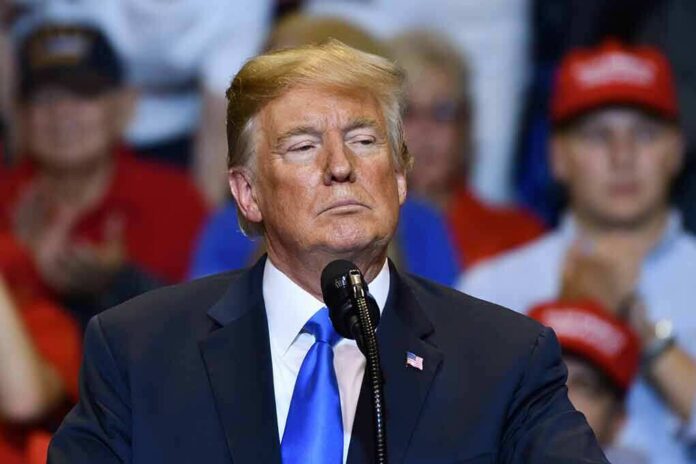
President Trump defended a blistering Ohio campaign ad this week, then turned on the ABC News reporter who questioned him about it, calling her “not a particularly attractive person.”
Quick Take
- Trump initially said he knew nothing about Vivek Ramaswamy’s ad targeting Ohio Democrat Amy Acton, then later called it “powerful.”
- Trump insulted ABC News correspondent Karen Travers after she pressed him on the ad’s contents.
- Ohio Governor Mike DeWine and Republican Congresswoman Ashley Hinson both called for the ad to come down.
- Vice President JD Vance praised Ramaswamy for having the “audacity” to run it anyway.
Trump Clashes With Reporter Over Ad Question
A reporter at the White House asked President Trump about a controversial ad from Vivek Ramaswamy’s Ohio governor campaign. Trump said he “didn’t know anything about it,” but added he had heard that the mother featured in the ad had “gone very rogue on the daughter.” He called the family fight unusual but said it had nothing to do with Ramaswamy.
Trump did not stop there. He turned his attention to the ABC News correspondent who asked the question, Karen Travers, and described her as “not a particularly attractive person.” The remark quickly became the headline moment of the exchange, overshadowing the substance of what he was actually being asked.
Ad Featuring Candidate’s Estranged Mother Sparks Backlash
The ad at the center of the fight features Donna Arthur, the estranged mother of Democratic Ohio governor candidate Amy Acton. In it, Arthur accuses her daughter of lying. Ramaswamy’s campaign confirmed it produced the ad, and it spent heavily to spread it, reportedly backing a four million dollar ad push in the race.
The ad drew criticism from both sides of the aisle. Ohio Governor Mike DeWine, a Republican, called for it to be taken down. Republican Congresswoman Ashley Hinson also criticized it. Acton’s campaign slammed Ramaswamy directly, framing the ad as an attack built on private family pain rather than policy.
Trump And Vance Stand Behind The Ad
Despite his early claim of not knowing about the ad, Trump later gave it a full endorsement. He called it “powerful” and asked, “Who wouldn’t use such an Ad?” He urged that it stay up, a sharp shift from his first response that suggested distance from the controversy.
Vice President JD Vance went further, publicly praising Ramaswamy for having the “audacity” to run the ad despite the bipartisan pushback. That public backing from the nation’s two top Republicans turned a local Ohio story into a national flashpoint just as the governor’s race heats up.
Trump Rages at ABC News Reporter Over Ramaswamy Ad Questioning: 'Not a Particularly Attractive Person' https://t.co/uY9DBT0Scc
— Mediaite (@Mediaite) October 23, 2026
Why The Media Fight Matters More Than The Headline Suggests
Conservatives have long argued that reporters focus on gotcha moments instead of asking straight questions about substance. This exchange fits that pattern. Instead of pressing Trump on whether the Acton family claims were true, the coverage zeroed in on his insult toward the reporter, turning a policy fight into a personality clash.
Research on attack ads suggests they rarely move the needle much with voters either way. A Yale-cited review of political advertising found such ads shift favorability ratings only slightly on average. That means the real fight here may be less about persuading Ohio voters and more about forcing Democrats to play defense and keeping the story alive in the press.
The Ohio governor’s race is now a proving ground for how far campaigns will go with personal attacks, and how the press chooses to cover the politicians who use them. Trump and Vance have made clear they are willing to defend a hard-hitting ad even as fellow Republicans call it too far. Ohio voters will ultimately decide if that bet pays off.