

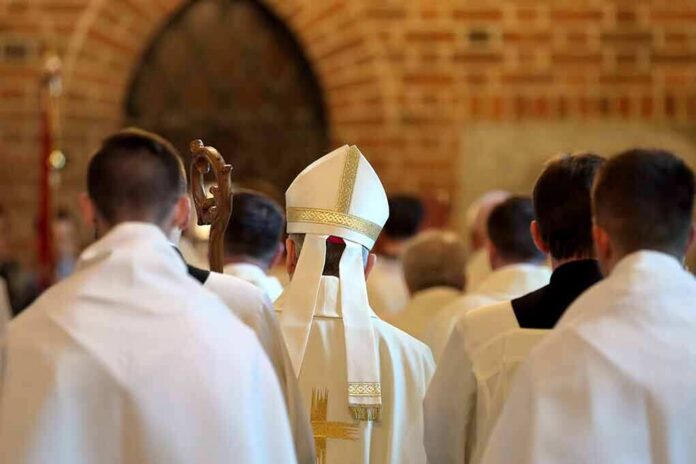
A Catholic cardinal said the Church is “not there to convert,” and Bishop Robert Barron answered with a firm defense of preaching Christ.
Story Highlights
- Cardinal Jean-Paul Vesco said the Church should not be a proselytizing institution in Algeria.
- Vesco called proselytism “poison” among monotheistic believers, favoring quiet witness.
- Bishop Barron pushed back, pointing to the Church’s mission to evangelize.
- St. John Paul II taught that proclamation aims at conversion, not coercion.
What Cardinal Vesco Said About Conversion And Proselytism
Cardinal Jean-Paul Vesco, who leads the Church in Algiers, said the local Church is “not a proselytising Church, not a Church that is there to convert,” but a part of the Algerian people. He argued that, among faiths that worship one God, proselytism is “poison,” since it treats the other’s religion as false. He has long stressed “discretion” and friendship as the highest form of mission, saying testimony should respect the other person’s faith and life.
Vesco’s stance reflects his setting. Algeria is a Muslim-majority nation, and the Catholic community there is small and international. He describes the Church as rooted in Algeria and open to the wider world, but not focused on gaining converts as an institutional target. He highlights living the Gospel through service, fraternity, and presence, and says those relationships can still “transmit something” of Christian faith without direct pressure to convert.
How Bishop Barron Framed The Church’s Mission
Bishop Robert Barron responded by defending the duty to evangelize. He underscored that the Christian call includes preaching Jesus Christ and inviting people to follow Him. He emphasized that true evangelization never uses force or tricks, but it does make a clear offer of the Gospel. That approach aligns with long-standing Catholic teaching that respects freedom while calling every person to a real decision of faith.
Saint John Paul II taught that proclamation aims at Christian conversion. He defined conversion as a personal choice to accept Jesus’ saving rule and become His disciple. He also said dialogue with other religions belongs inside the Church’s mission, but does not replace the mission to those who do not believe in Christ. A Vatican document likewise says “dialogue” and “proclamation” are two parts of one evangelizing mission, not rivals.
Where The Line Falls: Evangelization Versus Proselytism
The Vatican has drawn a firm line against coercion or manipulation. It teaches that evangelization seeks to convert only through the power of the message, never by pressure or enticement. Another Vatican statement says when a person freely decides to enter the Catholic Church, that choice should be respected and not smeared as “negative proselytism”. These rules protect conscience and keep the focus on truth, charity, and a clear call to follow Christ.
Cardinal Vesco’s shocking claim: Conversion is not the goal! – Joe McClane
Cardinal Jean-Paul Vesco, Archbishop of Algiers, says the Catholic Church is "not a Church that is there to convert" — and that in monotheistic religions "proselytism is poison." Joe McClane reads the…
— UponThisRock (@DoctrinalStones) October 29, 2026
Vesco’s words raise a practical question. If the Church is “not there to convert,” how do pastors preach and invite without crossing a vague line? Vesco urges witness through friendship and service, which is good and needed. But the Church also teaches that explicit preaching and a call to conversion are part of her duty, followed by teaching and the sacraments for those who respond. Friendship should open hearts; it should not silence the message.
Why This Debate Matters For Faith And Freedom
Americans know that freedom of religion means the right to share beliefs and the right to say no. That is why the Church’s model is simple and strong: preach clearly, never coerce. When leaders blur the aim of conversion, they risk shrinking the faith to private feelings and social work. The Catholic mission, like the great commission in Scripture, asks believers to make disciples, not by force, but by truth spoken in love.
Bottom Line For Readers Who Care About Clarity
Cardinal Vesco urges caution in a hard place, but his wording invites confusion. Bishop Barron’s answer brings needed balance. The Catholic path is both friendship and frank preaching. The Church rejects pressure and trickery. The Church also invites every person to meet Jesus and change their life. That is not “poison.” That is the heart of evangelization, taught across decades by the Vatican and by Saint John Paul II.
Sources:
lifesitenews.com, youtube.com, fides.org, press.vatican.va