

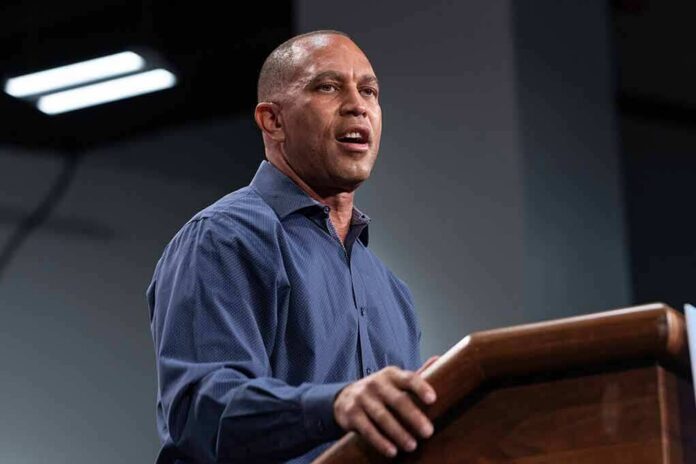
House Democratic Leader Hakeem Jeffries and J Street just helped defeat a plan to cut $3.3 billion in U.S. weapons for Israel, keeping taxpayer-funded arms flowing into a war that many scholars now openly call genocide.
Story Snapshot
- A Massie amendment to cut $3.3 billion in military aid to Israel failed after Jeffries and J Street opposed it.
- Despite 103 Democrats voting to block the weapons, party leaders worked together to protect the aid line.
- Jeffries and J Street called the amendment “overly broad,” but did not dispute claims U.S. arms are used in Gaza and beyond.
- Genocide scholars and activists are demanding an arms embargo, warning Congress is now “arming genocide” with U.S. tax dollars.
Massie’s Amendment: A Direct Shot at $3.3 Billion in Weapons
Representative Thomas Massie’s amendment to the 2027 State Department and national security funding bill aimed straight at the $3.3 billion Foreign Military Financing account for Israel. The text would have stripped that line from the bill and barred any funds in the package from being spent on Israel at all. In plain terms, this was the first real recorded House vote in this Congress on whether to keep writing a blank check for Israeli weapons, or finally shut it off.
The amendment did not touch President Trump’s broader national security agenda or other U.S. allies, but focused only on Israel’s slice of the foreign military financing pie. Supporters argued that American bombs, paid for by U.S. taxpayers, are falling on civilians in Gaza, the West Bank, and even Lebanon. For many members, this vote was their only clear chance to say “no” to more weapons without getting lost in procedural games or vague resolutions.
Jeffries and J Street Join Forces to Save the Aid
House Democratic Leader Hakeem Jeffries circulated a “Dear Colleague” letter telling Democrats he would vote against the Massie amendment and urging caution. He called the measure “overly broad” and claimed it could hit “humanitarian aid, refugee resettlement, peace-building and U.S. Embassy operations,” even though public summaries describe it as cutting military aid. On the same day, J Street issued a statement backing Jeffries, using the exact same “overly broad and poorly drafted” language.
Jeffries’ letter leaned on the authority of senior Democrats on appropriations and foreign affairs, plus J Street, to frame the amendment as sloppy rather than wrong on principle. Yet neither Jeffries nor J Street offered a detailed account-by-account breakdown proving that humanitarian programs would truly be blocked. At the same time, J Street openly encouraged some members to vote yes as a “signal” against unconditional military aid, showing they viewed the amendment as political theater more than a clean policy fix.
A Record Democratic Split Over Arming Israel
When the roll was finally called, 103 Democrats voted to cut the $3.3 billion funding line and block further weapons and aid to Israel. Ninety-eight Democrats voted no, ten voted present, and most Republicans opposed the amendment, so it failed 104–314. That vote marked a seismic shift: more than one hundred House Democrats were willing to be recorded in favor of ending Israeli military aid, even as their leadership worked to sink the effort.
Outside Congress, activists confronted Jeffries at events, accusing him of complicity in what they describe as genocide in Gaza and blaming him for weapons that killed thousands of children. The Council on American-Islamic Relations cited a resolution from the International Association of Genocide Scholars, which found Israel is committing genocide in Gaza, and called on Jeffries and other leaders to back a full arms embargo. This growing pressure highlights the widening gap between base voters and establishment Democrats on war, human rights, and use of U.S. tax dollars.
Genocide Allegations and the Question of U.S. Responsibility
Supporters of the amendment and many human rights advocates argue that U.S.-supplied weapons are being used by Israel in Gaza, the West Bank, and Lebanon. J Street itself admitted this vote was one of the few chances to express recorded opposition to how American military assistance has been used in these places. At the same time, allegations of “ethnic cleansing” and “genocide” in Gaza have moved from fringe rhetoric into mainstream academic and activist circles, including genocide scholars and major civil rights groups.
Fuck him and I am a Bernie Dem: House Minority Leader Hakeem Jeffries announced he will oppose a legislative amendment to cut $3.3 billion in U.S. military aid to Israel, while simultaneously calling for a major policy reset and future changes to security assistance
— Seven Days (@7HumpWump) July 26, 2026
What remains missing from the public record is a full, declassified chain of evidence showing exactly which U.S. weapons were used in which strikes, and which Israeli units carried them out. There is also no published inspector general finding yet that current aid flows clearly violate U.S. law, though legal experts are pushing for reviews under the Leahy Law and Arms Export Control Act. Still, the moral stakes are obvious: if Congress knows U.S. arms are fueling mass civilian death, continuing to fund them raises serious questions about American responsibility.
Democrats Reposition While Aid Keeps Flowing
Jeffries has started to talk about an eventual “change in direction” on U.S. aid to Israel, saying Israel’s advanced economy can pay for its own sophisticated weapons. J Street backs phasing out direct military aid by 2028, not cutting it off right now. Other Democrats are floating conditional aid plans, like tying weapons to delivery of humanitarian assistance, or backing bills that ban certain offensive arms sales while preserving missile defense cooperation.
Yet in the near term, the Massie amendment’s defeat means the full $3.3 billion in foreign military financing for Israel stays in place. For conservative readers, the pattern is familiar: Democratic leaders talk about “resetting” policy someday, while blocking concrete moves that would bite right now. As the Trump administration pushes to protect American sovereignty and end endless wars, this episode shows how entrenched the Democratic establishment remains in funding foreign conflicts, even over the objections of its own voters and many in the human rights community.
Sources:
original.antiwar.com, indepthnews.net, nytimes.com, english.aaj.tv, commondreams.org, jewishinsider.com, jta.org, instagram.com, democraticleader.house.gov, jstreet.org, liccardo.house.gov, military.com, congress.gov, beyer.house.gov, jpost.com, thehill.com