
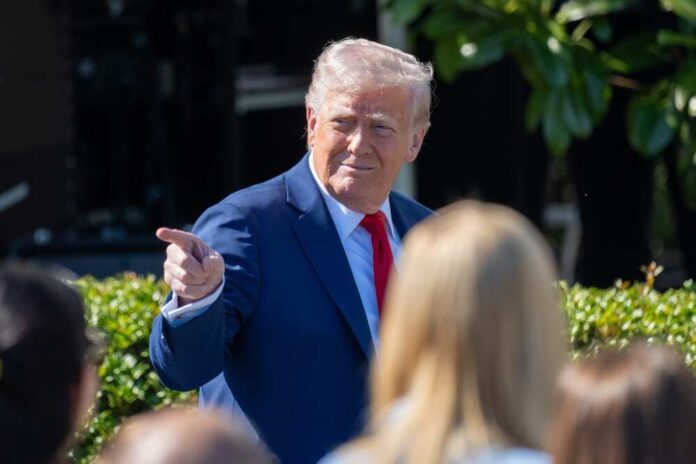
One exchange on Air Force One has reignited a blunt question Washington keeps dodging: if American weapons hit an Iranian school, who is accountable for the truth?
Quick Take
- A reporter confronted President Trump over reports that a girls’ elementary school in Minab, Iran, was struck on Feb. 28, killing roughly 165–175 people, mostly girls ages 7–12.
- Trump publicly suggested Iran was responsible and claimed Iran has Tomahawk missiles, a point disputed by later reporting and fact-checking referenced in the research.
- The Pentagon said the incident was under investigation, but lawmakers said promised answers were delayed past a requested deadline.
- Analysts cited in major reporting pointed to U.S.-origin munitions signatures, raising questions about weapon selection, targeting, and battle-damage assessment.
Air Force One Confrontation Puts Civilian Casualties Back on the Record
President Donald Trump faced pointed questions after a missile strike hit the Shajareh Tayyebeh elementary school in Minab, southern Iran, on Feb. 28, 2026, during the opening day of U.S.-Israeli strikes. Reporting summarized in the research places the death toll around 165–175, with most victims described as girls ages 7–12. When pressed about responsibility, Trump deflected and said the matter was under investigation.
Trump’s answer centered on the claim that Iran has Tomahawk missiles and that Iran’s weapons are “very inaccurate,” implying Tehran could have caused the strike. The research describes that claim as false and notes subsequent analysis pointing away from Iranian possession of Tomahawks. In practical terms, the exchange mattered less as political theater than as a test of whether the federal government can provide basic clarity when civilians die in a war it authorized.
Competing Weapon Theories Highlight a Familiar Oversight Problem
The available reporting does not treat the strike as a settled case. The research describes evidence pointing to U.S. weapons—either Tomahawk cruise missiles or the Precision Strike Missile (PrSM). A separate strike reportedly hit another school or sports hall near Lamerd, killing 21, and was associated with PrSM in later analysis. The Pentagon’s public posture remained “investigating,” while weapon details stayed limited.
That gap—deadly event first, clear explanation later—feeds bipartisan suspicion that institutions protect themselves before informing the public. Conservatives often see this pattern in “deep state” terms, while many on the left see it as impunity for the powerful. Either way, the same civic principle applies: a constitutional republic cannot function when the commander-in-chief, the bureaucracy, and Congress talk past each other on a basic question of what happened and why.
Senate Pressure Grows as the Pentagon Withholds Specifics
Sen. Tammy Baldwin and other lawmakers pressed the Trump administration for answers about the school bombing and civilian casualties, according to the Senate press release in the research. The request sought details on what happened and how the operation was conducted, including concerns about targeting processes. The research indicates a requested response date of March 18 passed without the full set of answers lawmakers wanted, reinforcing claims that oversight is struggling to keep up.
Republicans control Congress in 2026, but the oversight dilemma is not purely partisan. Democrats can use civilian-casualty allegations to attack Trump’s war leadership, yet the core issue—transparency in the use of lethal force—also concerns constitutional conservatives who believe war powers and accountability should not disappear inside the national-security bureaucracy. When an “investigation” becomes an open-ended holding pattern, trust erodes and rumors fill the vacuum.
Strategic and Economic Blowback Extends Beyond the Battlefield
The research describes broader consequences: anti-U.S. protests abroad, an information advantage for the Iranian regime, and rising risk to U.S. forces if retaliation escalates. The report also notes an oil spike tied to Hormuz fears, highlighting how kinetic decisions quickly hit household costs. For Americans already frustrated by inflation and economic instability, Middle East escalation carries a familiar sting: foreign crises can become domestic pain through energy and supply-chain shocks.
VIDEO – Reporter Confronts Trump over Iran School Bombing: ‘Who Fired That Missile?’ https://t.co/krnXV36hNd
— Grabien (@GrabienMedia) May 9, 2026
Uncertainty also lingers around the PrSM itself, which the research describes as new and previously uncombat-tested, with analysts raising reliability questions. That detail matters because “precision” is the moral and strategic justification the modern national-security state often uses to defend strikes near civilian areas. If the government cannot quickly explain weapon choice, target proximity, and battle-damage assessment, the public is left with competing narratives—and a worsening belief that officials answer to incentives, not citizens.
Sources:
Trump Accused of Bombing Another School With ‘Untested’ Missile
Baldwin Presses Trump Admin for Answers on the School Bombing and Civilian Casualties in Iran