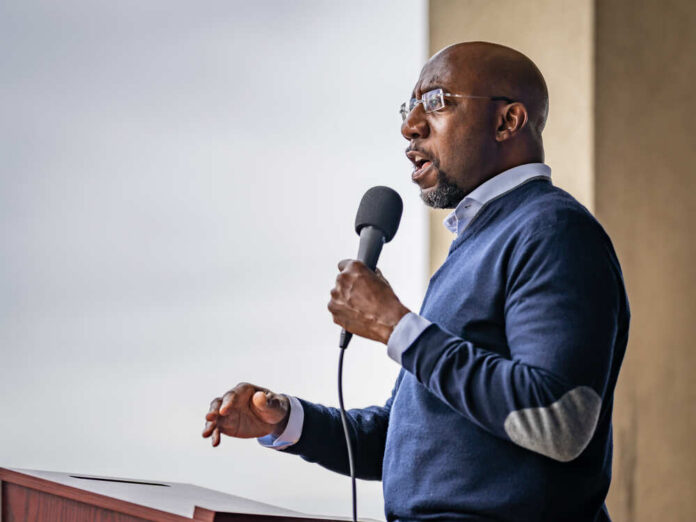
Sen. Raphael Warnock is framing pro-Trump evangelical support as a spiritual crisis—one that reopens America’s deepest church-and-politics fault lines.
Quick Take
- Warnock questioned whether evangelical leaders who back President Trump have replaced “private morality” with political loyalty.
- He compared today’s Christian political defenses to past uses of Scripture to justify slavery and segregation.
- The clash highlights a widening divide between Black church liberation theology and white evangelical political power.
- With Trump back in office, the fight is shifting from campaign rhetoric to who speaks for “Christian values” in public life.
Warnock’s “Who Is Their God?” Challenge Lands in a Different America
Sen. Raphael Warnock, a Georgia Democrat and longtime pastor at Atlanta’s Ebenezer Baptist Church, used a recent interview with David Remnick to challenge evangelical Christian leaders who support President Donald Trump. Warnock argued that some leaders who once insisted on strict personal morality now treat Trump as a kind of political “Messiah,” despite his well-known scandals and felony convictions. His central question—“Who really is their God?”—was aimed at exposing what he sees as displaced worship and moral inconsistency.
Warnock’s criticism also drew directly from America’s religious history, where Scripture was invoked to defend slavery and later segregation. He paraphrased themes associated with Martin Luther King Jr.’s “Letter from Birmingham Jail,” which criticized church leaders who preferred order and political comfort over moral clarity. Warnock’s message was not simply partisan; it was theological, suggesting that when religious leaders excuse wrongdoing for political gain, they risk turning faith into a tool of power rather than a check on it.
Why Warnock’s Argument Hits Evangelicals Where It Hurts
Warnock’s comments target an enduring reality: white evangelicals have remained one of Trump’s strongest voting blocs even after criminal convictions and repeated controversies. The research cited in the underlying coverage describes evangelical support at levels above 80% in the post-conviction political era, a statistic Warnock uses to sharpen his point about moral tradeoffs. For many conservative Christians, the defense is straightforward—policy outcomes on abortion, courts, and cultural issues outweigh personal failings.
That logic, however, is exactly what Warnock is challenging. He contrasts today’s results-driven political calculus with earlier evangelical messaging that emphasized “family values” and private morality as public requirements. To conservative readers, the bigger takeaway may be that Democrats are increasingly trying to split the religious right by making the argument personal, not merely political. The weakness in Warnock’s case is that it treats a coalition choice as if it were a confession of faith, which many believers reject as a category error.
Black Church Tradition vs. Culture-War Christianity
Warnock’s worldview is grounded in the Black church tradition that developed under slavery, where biblical reading emphasized deliverance—both from personal sin and from the injustice of slavery itself. That tradition stands in sharp contrast to strands of 19th-century American Christianity that defended slavery by citing specific passages about servitude. The Baptist News analysis referenced in the research argues that critics often misunderstand Black theology by treating it as radical politics rather than a historically rooted religious response to oppression.
This matters because the fight is not just about Trump; it is about what kind of Christianity has moral authority in American public life. The research notes that Republicans previously attacked Warnock’s theology during his Senate campaigns, linking him to controversial figures and labeling his tradition as extreme. In 2026, that earlier playbook collides with a new environment: Trump is no longer an outsider candidate but the sitting president, and critics are pressing the question of whether political loyalty is reshaping doctrine, not merely voting behavior.
The “Christian Nationalism” Debate Adds Fuel, But Evidence Varies
The research also points to growing media attention on Christian nationalism, including commentators who accuse some pro-Trump activists of advocating for government enforcement of “biblical morality.” This is where evidence can get uneven. Video commentary cited in the research claims certain figures echo past arguments that treated slavery as a regulated institution rather than a moral atrocity, but these broader labels often depend on interpretation, not just direct quotation. Readers should separate documented statements from rhetorical packaging.
Still, the political stakes are real. When religious language becomes a blueprint for state power, conservatives who care about limited government should ask hard questions about enforcement, bureaucracy, and whose interpretation controls policy. The First Amendment was designed to prevent the federal government from becoming an umpire of doctrine. If America’s churches want moral influence, the most constitutionally stable path is persuasion and voluntary association—not turning Washington into a national pulpit with agencies behind it.
What This Means for Trump’s Coalition Heading Into 2026
Warnock’s attack line is likely to spread because it is simple and emotionally charged: faith leaders who excuse sin for power resemble past Christians who excused slavery for profit and social order. That comparison will infuriate many evangelicals who view it as slander, and it will energize Democrats who want to portray the Trump-era religious right as hypocritical. The research also notes a lack of prominent rebuttals in the sampled results, suggesting the online debate is running ahead of formal institutional responses.
For conservatives, the practical question is whether this fight pushes believers into deeper tribalism or toward clearer standards that outlast any one politician. Many Trump voters are already exhausted by years of cultural chaos, inflationary spending, and border breakdowns; they do not want another moral panic manufactured by media elites. But the church cannot outsource its witness to politics without consequences. Warnock is betting that voters will eventually demand a consistency that campaigns rarely provide.
Sources:
Senator Raphael Warnock Asks of Evangelicals Supporting Trump: ‘Who Really Is Their God?’
A response to critiques of Rev. Warnock, Black theology and the Black church tradition