

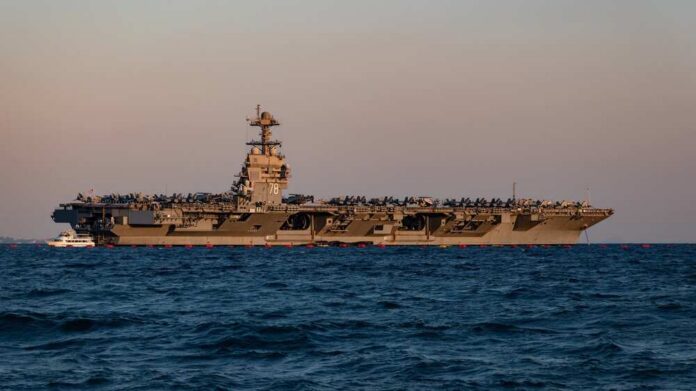
America’s $13 billion supercarrier USS Gerald R. Ford nears psychological breaking point after 11 months at sea, exposing Navy’s dangerous overstretch under prior weak leadership now being fixed by President Trump.
Story Highlights
- USS Gerald R. Ford’s deployment stretched from 7 months to 11, ranking among longest in Navy history due to global commitments outpacing fleet capacity.
- March 2026 fire injured sailors and damaged living quarters amid sewage failures and crew fatigue.
- Crew faces severe mental health risks like PTSD from combat shifts between Venezuela and Iran operations without rest.
- Experts warn of months-long recovery sidelining the carrier, highlighting need for stronger Navy under Trump’s defense buildup.
Deployment Extended Far Beyond Limits
USS Gerald R. Ford (CVN-78) deployed in June 2025 for a standard six-to-seven-month rotation supporting Venezuela operations. Mission demands shifted it to intensive Middle East combat against Iran by early 2026. By February 2026, the carrier surpassed 230 days at sea, becoming the third-longest deployment in U.S. Navy history. This overextension pushed the newest Ford-class supercarrier, equipped with over 75 aircraft including F-35C jets, beyond design parameters. Navy resource gaps forced the $13 billion asset to serve as a lone workhorse.
March Fire Exposes Infrastructure Failures
A damaging fire erupted in March 2026, injuring sailors and ruining living spaces including over 1,000 mattresses. Navy claims propulsion remained unaffected, but analysts question cumulative damage from prolonged operations. Persistent sewage system breakdowns caused toilet clogs and backups, fueling crew frustration and distress. These failures in the cutting-edge carrier, featuring EMALS and AAG systems, underscore vulnerabilities when maintenance lags behind endless global policing demands inherited from prior administrations.
Crew Reaches Psychological Breaking Point
Sailors endure extreme fatigue from non-stop operations, heightening flight deck accident risks and mental health crises. National Institute of Health research links extended deployments to PTSD and anxiety from combat exposure. Senator Tim Kaine voiced concerns over the toll on personnel. Families suffer prolonged separations amid hazardous conditions. Navy leaders admit such extensions disrupt lives and readiness, yet combatant commanders’ demands exceed available carriers, straining our warriors who deserve better support.
Defense expert Kris Osborn calls this a systemic mismatch between commitments and fleet size. The Ford absorbs missions others cannot handle due to maintenance backlogs. Navy official Kilby noted the deployment nears record 11 months. Crew morale plummets from poor conditions, threatening retention in an all-volunteer force vital to national security.
Long-Term Readiness at Risk
Post-deployment, the Ford faces over six months in yard for repairs, wear recovery, and crew retraining, leaving Navy short a key asset during crises. This reveals insufficient carriers for worldwide demands, inviting adversary tests like precision missile strikes on fatigued ships. President Trump’s 2026 budget boosts defense by $113 billion for more ships, jets, and missile shields, rejecting past underfunding that left sailors overworked. Stronger fleets protect liberty without overtaxing patriots.
Stakeholders from crew to Congress demand fixes. Osborn urges fleet expansion to distribute loads fairly. Overstretch erodes the naval dominance conservatives champion for peace through strength. Trump’s priorities restore readiness, cutting waste elsewhere to fund real defense.
Sources:
Kaine Presses Navy on Extended Deployment of USS Gerald R. Ford
Navy’s Kilby Signals USS Ford Could See 11-Month Deployment Approaching Record Length