
Mexico’s president drew a hard red line against U.S. troops on her soil even as cartel chaos crosses the border, forcing Washington to recalibrate how it fights fentanyl without ceding leverage.
Story Snapshot
- Mexico’s President Claudia Sheinbaum rejected any U.S. military operations in Mexico while pledging cooperation under strict sovereignty rules.
- U.S. officials prepared counter-cartel military options after new FTO designations; planning continues without deployment.
- A near-finished bilateral security pact emphasizes sovereignty, territorial respect, mutual trust, and cooperation.
- USMCA’s 2026 review and migration politics shape leverage and risks in security negotiations.
Mexico Sets a Sovereignty Line While Signaling Limited Cooperation
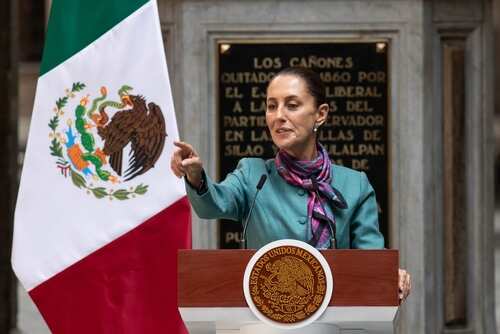
President Claudia Sheinbaum said Mexico will coordinate on security with the United States but ruled out any “invasion” or presence of American troops, stating enforcement against cartels must occur on U.S. soil. She tied this position to a bilateral security pact guided by four principles—sovereignty, territorial respect, mutual trust, and cooperation—that Mexico says is nearly complete, though not yet signed. This approach preserves Mexico’s decision-making authority while keeping channels open for joint action.
Watch: Mexico’s President Says U.S. Forces Are Unwelcome in Her Country – YouTube
U.S. officials earlier confirmed that President Trump directed the Pentagon to develop options for operations against cartel groups designated as foreign terrorist organizations, signaling tougher posture against fentanyl trafficking. Planning does not equal imminent deployment, and legality and feasibility questions remain unresolved. Mexico’s categorical refusal of U.S. troops narrows the practical toolbox, pushing both sides toward intelligence sharing, financial sanctions, extraditions, and joint investigations inside a sovereignty-respecting framework.
After Pres. Trump directed the Pentagon to prepare options for the possible use of U.S. military force against drug cartels, Mexican Pres. Sheinbaum says she is opposed to the U.S. military conducting operations in her country. @christianeabc reports. https://t.co/fTWEtUH4to pic.twitter.com/OpM7rNCXqt
— World News Tonight (@ABCWorldNews) August 10, 2025
What the Forthcoming Security Agreement Likely Enables—and Forbids
Mexico’s outlined principles imply greater cooperation on information exchange, coordinated investigations, and judicial processes while explicitly barring foreign troop presence. The design channels pressure toward measurable law-enforcement outcomes rather than unilateral kinetic actions that would violate sovereignty. The pact’s emphasis on trust and territorial respect aims to institutionalize cooperation while preventing mission creep on Mexican soil.
Timing and full text of the agreement remain undecided, leaving operational details opaque. Still, the structure signals a durable precedent: bilateral mechanisms over boots-on-the-ground proposals. For Washington, the question becomes how to achieve disruption—precursor tracking, sanctions on enablers, targeting cross-border logistics—without direct incursions. For Mexico, reaffirming sovereignty shores up domestic legitimacy amid violence headlines while avoiding escalation that could unsettle trade and investment.
Leverage, Limits, and the USMCA Review Looming in 2026
Trade, migration enforcement, and the 2026 USMCA joint review form the backdrop to today’s security bargaining. The United States can wield tariffs and migration cooperation demands to seek faster action against cartels, while Mexico controls territorial operations and prosecutions. Both sides have incentives to codify collaboration to protect broader economic interests. Escalatory rhetoric or threats could rattle markets; a signed pact could stabilize expectations and concentrate resources on joint, legally grounded action.
Short term, friction could rise if military-option talk persists publicly, but Mexico’s clear boundaries may funnel efforts into formal cooperation under the new agreement. Long term, a pact that prioritizes intelligence sharing, extraditions, and financial pressure—while barring foreign troops—could become the template for sustained, sovereignty-respecting action. For American communities hurt by fentanyl, results will hinge on tightening supply chains, choking off financing, and speeding coordinated prosecutions rather than deploying U.S. forces across the border.
Sources:
U.S.-Mexico Relations Under Sheinbaum and Trump