
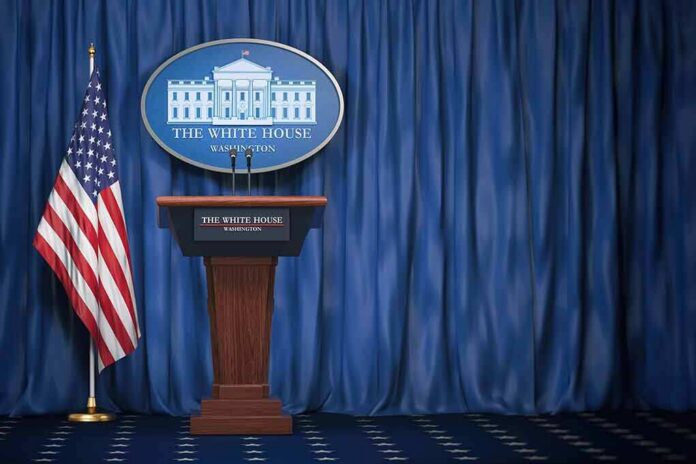
A federal judge ruled the White House violated the Associated Press’s free speech by tying press access to a wording demand, putting the First Amendment at center stage.
Story Highlights
- A court found the White House violated free speech by limiting AP access over terminology.
- Appeals court later allowed some restrictions to continue during the case.
- AP says access was cut for Oval Office, Air Force One, and pool spots after a word dispute.
- Press groups urged reversal, warning the limits undercut core First Amendment principles.
What Triggered the Showdown Over Press Access
Associated Press reported it was told on February 11, 2025, its reporters would lose access to limited spaces unless it adopted the administration’s preferred “Gulf of America” terminology. The outlet then filed suit on February 21, naming senior White House officials and arguing the restriction punished speech. The access at issue covered the Oval Office, Air Force One, and other tight venues that the White House opens to small press pools.
The complaint said the ban was viewpoint retaliation that would chill reporting by others. It asked the court to order access restored and to block officials from using editorial choices as a condition for entry. The filing framed the harm as ongoing and concrete, since crucial presidential spaces were open to others but not to Associated Press journalists after the terminology dispute.
How the Courts Weighed the First Amendment Claim
United States District Judge Trevor N. McFadden ruled the White House violated Associated Press’s free speech rights by excluding the outlet from certain presidential events because of its editorial choice on terminology. The ruling rested on a line of cases that say the government cannot open limited press access and then selectively shut doors based on viewpoint. The decision ordered reinstatement to covered events on First Amendment grounds.
The litigation then moved to the appellate stage, which produced a mixed, time-bound result. Reuters reported the appeals court granted the administration the ability to keep some limits in place while the case proceeded. That temporary step confirmed there were concrete restrictions on participation, even as the broader constitutional merits continued to be argued on appeal.
What Spaces Were Restricted and Why It Mattered
Associated Press detailed lost access to the Oval Office, Air Force One, and other small, high-impact venues where space is scarce and the White House uses press pools. These are the settings where presidents meet leaders, sign orders, and answer brief questions that shape the day’s news. When one outlet is cut out over viewpoint, it changes who can witness and question power in the moments that matter most for public accountability.
MAMDANI | BANNED WHITE HOUSE OUTLETS WELCOME AT NYC MEETING WITH TRUMP
New York City Mayor Zohran Mamdani said CNN, MS NOW and Politico — the outlets recently barred from the White House — would be welcome to cover his meeting with President Donald Trump at Gracie Mansion.… pic.twitter.com/LoXkrrBZWm
— CSB News USA (@csbnewsus) September 22, 2026
Press groups, including the White House Correspondents’ Association and the television pool, publicly pushed for a reversal. Their statements warned the ban undermined core First Amendment protections and standard press-pool practices that let all Americans, through competing outlets, see the presidency up close. Their reaction showed this was not just an inside-media spat but a basic rules question for coverage of the commander in chief.
The Constitutional Line and What Comes Next
Reuters and Politico explained the central legal line: presidents have leeway to manage scarce space, but the government cannot condition access on a favored viewpoint once it opens a forum for a class of journalists. That is why Judge McFadden’s order focused on viewpoint retaliation, and why the appeals court’s temporary step did not end the merits fight. The case’s record shows a sustained access dispute with named decision-makers and concrete limits.
Why This Matters to Readers Who Value Limited Government
Government should not pick winners in the press based on speech. When any administration ties access to wording, it turns a practical space limit into leverage over coverage. That risks chilling tough questions, and it invites future officials to push even harder lines. Courts exist to draw the boundary: manage space, yes; punish viewpoint, no. This case tests that line in real time, with rulings on both sides shaping how the First Amendment works at the White House door.
Sources:
apnews.com, rcfp.org, reuters.com, ap.org