

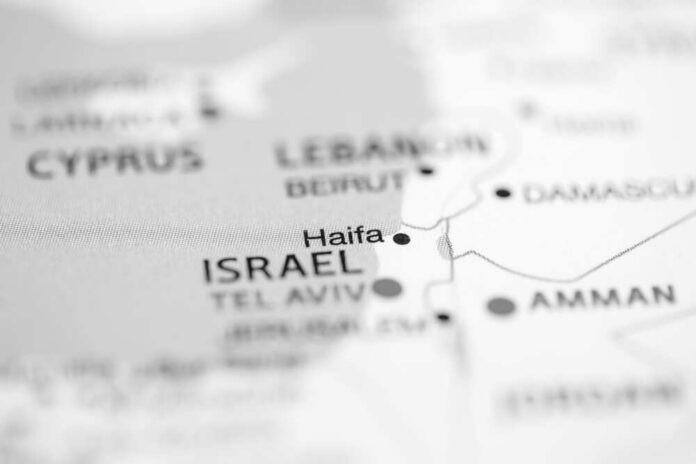
Nonstop sirens over Haifa are a blunt reminder that Iran-backed rockets—not campus protests—still set the security agenda in the Middle East.
Quick Take
- Hezbollah said it fired a rocket barrage at an Israeli naval base in Haifa on March 3, framing it as retaliation for Israeli strikes in Lebanon.
- Reporting differs on the precise target near Haifa, with some accounts describing a naval base and others an air defense or missile-defense site.
- Israeli reporting said rockets launched toward Tel Aviv and Haifa were intercepted and no injuries were reported in that specific salvo.
- A broader early-March escalation included Israeli strikes in Beirut and southern Lebanon and continued Hezbollah launches toward northern and central Israel.
Hezbollah’s Haifa claim spotlights a widening strike radius
Hezbollah announced on March 3 that it launched a rocket barrage targeting an Israeli naval base in Haifa, northern Israel, describing the attack as retaliation for Israeli airstrikes on Lebanese territory. State-linked outlets carried Hezbollah’s claim and emphasized “advanced” rockets and a response to what it called Israeli aggression. The claim matters because Haifa is a major population and industrial center, and repeated sirens underscore how quickly a border fight can reach deeper into Israel.
Other reporting around the same time described a rocket-and-drone strike aimed not at a naval facility but at a missile-defense or air-defense site near Haifa. That discrepancy does not change the central verified fact: projectiles were launched toward the Haifa area during a fast-moving escalation in early March. The conflicting target descriptions highlight a familiar fog-of-war problem for analysts and citizens alike—combatants message for deterrence, while independent confirmation of what was hit can lag or remain unclear.
Israel’s response: interceptions, strikes, and pressure on Hezbollah’s network
Israeli military reporting said incoming rockets aimed toward Tel Aviv and Haifa were intercepted and that there were no injuries reported from that particular launch. Separately, the broader campaign in early March included Israeli strikes expanding beyond southern Lebanon into Beirut, with targets described across multiple reports as tied to Hezbollah infrastructure, media, and Iranian-linked elements operating alongside the group. The pattern suggests Israel’s focus remained on degrading launch capability and command support, not simply trading fire across the border.
Accounts compiling early-March events described a sharp spike in launches after the collapse of a prior ceasefire, alongside Israeli ground and air operations in southern Lebanon. A UN-linked monitoring presence has been referenced as tracking violations, and cumulative tallies cited in research point to hundreds of missiles launched over a matter of days. At the same time, details about leadership impacts and precise battle damage remain uneven across sources, meaning readers should separate confirmed interceptions and reported timelines from claims about specific high-value targets.
Regional stakes: Iran’s shadow, Syria friction, and escalation risk
Research summaries describe Hezbollah as operating within an Iran-aligned axis, with references to Iranian Quds Force activity and reported losses among Iranian-linked commanders during Israeli strikes. Additional reporting described clashes and tensions along the Syria-Lebanon frontier, suggesting even neighboring regimes and armed actors do not always align cleanly when Hezbollah forces move or reinforce. The strategic point is straightforward: when rockets reach Haifa and strikes reach Beirut, the conflict’s center of gravity shifts from a border contest to a regional pressure cooker.
What American conservatives should watch: deterrence, energy targets, and “ceasefire” reality
For Americans watching from afar—especially those frustrated by years of diplomatic wishful thinking—the Haifa sirens are a case study in why paper ceasefires often fail when terrorist or militia forces retain rockets and external backing. Haifa’s industrial and energy-related infrastructure is frequently cited as strategically significant, and threats to ports and energy nodes can ripple into global markets. The available reporting does not prove specific damage at those sites, but it does show the intent to pressure major national assets through long-range fire.
Nonstop sirens in north as Hezbollah fires at Haifa
About 10 rockets and drones set off fresh alerts across the Galilee after a heavier barrage earlier in the night, while Israeli strikes send smoke billowing over Beirut’s Dahieh; …https://t.co/q6u1GBexeH pic.twitter.com/7VjYjlXQu0
— Ynet Global (@ynetnews) March 11, 2026
Several key uncertainties remain based on the provided material: exactly which Haifa-area facility was targeted in the initial Hezbollah claims, what physical damage resulted, and how much of the public narrative is deterrence messaging versus confirmed effects. Still, the broad direction is not ambiguous—early March featured repeated launches, repeated Israeli strikes, and a collapsing restraint framework. If the rocket threat persists, the next headlines will likely hinge less on statements and more on whether interceptions keep pace and whether the conflict pulls in more state-level actors.
Sources:
Hezbollah Claims Rocket Attack on Israeli Naval Base in Haifa
Hezbollah claims rocket, drone strike on Israeli missile defense site near Haifa
Hezbollah claims striking Israeli naval base in Haifa
IDF says Hezbollah launched three rockets at Tel Aviv and Haifa; no injuries reported
March 9, 2026: Hezbollah Fires Heavy Barrage at Tel Aviv, Haifa (Marc Schulman)
Hezbollah formally enters conflict, fires rockets at Mishmar military site near Haifa