
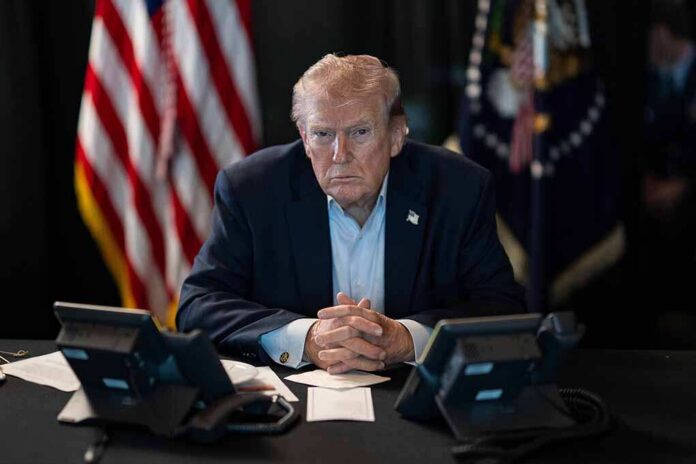
A seven-second clip from an Oval Office event sparked a media firestorm, but the fuller record shows a fight over framing more than facts.
Story Snapshot
- Video from a June 4 Oval Office announcement shows President Trump closing his eyes; outlets disagree on whether that means “asleep.”
- The White House denied he slept and said his eyes were open in the viral clip; supporters cite his demanding schedule.
- Senator Marco Rubio testified he has never seen Trump fall asleep in meetings, despite critics sharing other clips.
- The dispute centers on interpreting short video moments, not on verified proof of sleep.
What the Oval Office Video Shows and What It Does Not
Footage from a June 4, 2026 Oval Office coal announcement shows President Trump with eyes closed for brief moments while the Energy Secretary spoke, which critics cast as dozing. A fact-check said the full video shows several eye-closure moments, but it does not prove sleep in a medical sense. It documents what viewers can see, not what he heard or understood. The core question is interpretation, not whether video exists.
The viral clip that fueled the uproar runs about seven seconds. A separate fact-check reviewed a longer recording and reported Trump reopened his eyes about four seconds into the short segment. That analysis concluded the video does not show him asleep or unconscious. Both sides point to the same event but draw different meanings from brief eye closure. The facts are on tape; the claims about sleep are not settled by that tape alone.
White House Response and Supporters’ Case
The White House Rapid Response account said Trump’s eyes were open in the circulated clip and blasted the allegation as nonsense. A spokesperson described Trump as highly energetic. Senator Marco Rubio backed that view under questioning, saying he has never seen Trump fall asleep and noting late-night calls as evidence of his pace. Supporters frame the uproar as partisan theater using a few seconds of video to smear a president they oppose.
Rubio’s statement has become a key sound bite for defenders. He argued Trump “doesn’t sleep,” pointing to direct experience and calls at two in the morning. That testimony pushes back on claims based on body language alone. It also reminds viewers that a still frame or a pause can mislead. Even so, critics counter with other videos from different dates, while the administration stresses that none prove loss of alertness. The clash remains about meaning, not raw footage.
Critics’ Argument and the Limits of Visual Evidence
Critics circulate multiple clips from public events to claim a pattern and question attentiveness. A review by one outlet said the Oval Office footage showed several apparent nod-off moments. Another hearing featured video from a cabinet meeting to challenge Rubio’s statement. Yet those items still hinge on surface cues—closed eyes or posture—without audio signs like snoring or a missed response. Visuals can suggest a story, but they are not proof by themselves.
Short, decontextualized video often drives partisan narratives because it looks like proof at a glance. Here, a camera angle, a pause, or a blink can read as dozing when looped online. Responsible reporting asks what the video can and cannot resolve. It can show eyelids and head position. It cannot alone show awareness or fitness for duty. That is why the most grounded take recognizes an interpretation fight rather than a settled fact about sleep.
What Matters for Readers and the Work Ahead
Viewers who want the truth should demand full, unedited event recordings with time codes and audio. That record can show what was said before and after the eye-closure moments and whether Trump responded right away. Press and public can then judge attention, not a freeze frame. Until then, treat quick clips as incomplete. Readers deserve clarity, not spin that erodes trust and distracts from policy work on energy, costs, and securing our border.
The bottom line is simple. The video exists and shows brief eye closures. One fact-check says that does not prove sleep. The White House denies he slept and points to a demanding schedule. Rubio says he has never seen him fall asleep. Critics push a pattern based on short clips. All those points can be true at once. The wise path is to check the full record and stay focused on results that affect families, safety, and the Constitution.
Sources:
soapcentral.com, thedailybeast.com, lieu.house.gov, aol.com