A visiting U.S. lawmaker just warned Taiwan that “time is short” to arm itself with drones as China’s military pressure grows.
Story Snapshot
- U.S. Representative Young Kim urged Taiwan’s Legislature to quickly pass a NT$210 billion drone procurement bill to counter rising Chinese threats.
- Taiwan’s Cabinet plan would fund over 200,000 attack drones, plus surveillance drones and unmanned boats, for asymmetric defense against China.
- Opposition parties in Taiwan back drone funding in principle but want the money in the regular annual budget, not a special Cabinet bill.
- President Trump and Congress are driving a broader U.S.–Taiwan drone partnership to build a China-free defense supply chain.
U.S. Warning: ‘Time Is Short’ For Taiwan’s Drone Defenses
Visiting U.S. Representative Young Kim stood in Taipei and told Taiwan’s leaders bluntly that “time is short” to boost the island’s drone power as China steps up threats. Kim led a bipartisan congressional group that met President Lai Ching-te and pressed Taiwan’s Legislature to move fast on a major drone procurement bill. She pointed to recent joint naval patrols by China and Russia in the Pacific as a clear sign that America’s allies must harden their defenses quickly.
Kim’s message tracked closely with lessons from the wars in Ukraine and Iran, where cheap, mass-produced drones have changed modern combat. She said drones are now “central to warfare” and urged Taiwan’s lawmakers to “build and buy as many drones as possible, and do it quickly.” For conservative Americans, this fits a broader concern: our allies must carry their share of the load, and they must do it now, not after more years of committee delays and political games.
Inside Taiwan’s NT$210 Billion Drone Push
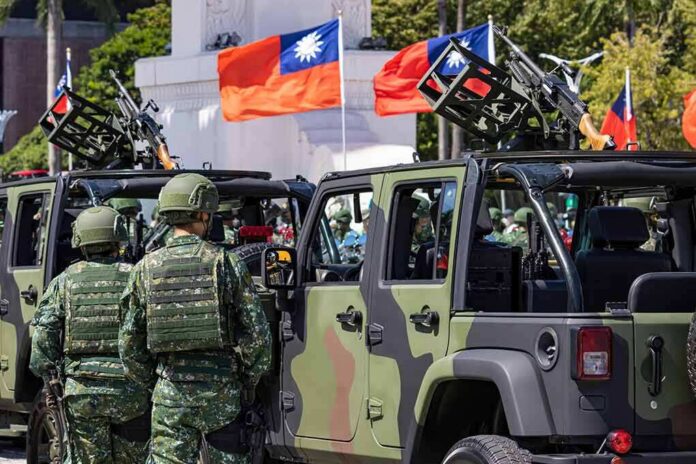
Taiwan’s Cabinet has put forward a special NT$210 billion bill to buy domestically made reconnaissance and attack drones plus unmanned surface vessels. Government figures show the plan would procure about 1,446 surveillance drones, 208,200 attack drones, and 1,320 small suicide unmanned boats between August 2026 and the end of 2031. The goal is simple and aligned with U.S. advice: build an asymmetric force that can punish any Chinese invasion, using many smaller smart systems instead of only big legacy platforms.
President Lai’s team also wants Taiwan’s defense spending up to five percent of its gross domestic product by 2030, with drones as a key focus. Taiwan aims to be able to produce roughly 100,000 drones a month by 2030, a scale meant to overwhelm any communist aggressor with swarms of unmanned systems. For American readers, this is exactly the kind of self-reliant deterrence we have long called for from partners: building their own industrial strength instead of leaning forever on U.S. hardware.
Budget Fight In Taipei: Special Bill Versus Regular Funding
Despite the shared sense of danger, Taiwan’s politics have turned the drone plan into a budget fight rather than a debate over whether drones are needed. The main opposition party, the Kuomintang, supports drone spending but wants to put roughly NT$240 billion into the normal annual budget, capped at NT$40 billion per year, instead of a one-off Cabinet special bill. Other parties have filed their own draft bills, so lawmakers are now weighing at least a dozen competing funding proposals alongside the Cabinet’s plan.
Taiwan’s Defense Ministry has warned publicly that stalled arms bills and special budgets risk derailing both U.S. weapons deals and domestic drone production if they are not sent to committee soon. That concern echoes what Kim told Taiwan’s leaders: procedural delays can be just as dangerous as outright cuts when a hostile regime is watching for weakness. From a constitutional conservative angle, this raises a familiar tension we know well at home—balancing firm legislative oversight with the hard reality that wars, and threats of wars, do not wait for perfect process.
U.S.–Taiwan Drone Partnership And China-Free Supply Chains
Back in Washington, lawmakers from both parties are pushing new tools to deepen U.S.–Taiwan drone cooperation and keep Communist China out of our defense supply chains. The Blue Skies for Taiwan Act of 2026, led in the Senate by Ted Cruz and others, aims to expand Taiwan’s role in building unmanned aerial systems that do not depend on Chinese technology or parts. The bill would set up a “Blue UAS Working Group” led by the Departments of State and War to audit Taiwan’s drone production capacity and identify trusted suppliers for U.S. defense programs.
At the same time, the latest National Defense Authorization Act requires the Pentagon to seek a joint program with Taiwan by March 2026 to field more drones and counter-drone systems. Congress has already authorized up to US$1 billion for Taiwan-related security cooperation under that defense bill, which now awaits President Trump’s signature. Together, these moves show a clear strategic line: build a network of free-world drone makers, cut out Beijing’s influence, and make sure Taiwan has both the tools and the industry needed to stand firm against communist aggression.
What It Means For American Conservatives
For American conservatives, this Taiwan drone debate matters on several levels that go far beyond one island’s budget rules. First, it is about standing up to the Chinese Communist Party with real strength, not empty speeches, and making sure our allies have skin in the game. Second, it is about securing supply chains for critical defense technology so our military is never dependent on a hostile regime for key parts. Third, it reminds us that even friendly democracies can let politics slow needed security steps if citizens and lawmakers lose sight of the stakes.
President Trump and Congress are sending a clear signal through these drone measures: the free world is drawing a hard line against communist expansion, and Taiwan must move with urgency too. As Kim said, “time is short,” and the island’s leaders now have a choice—either pass a strong, swift drone bill and match words with action, or let process fights and opposition caps sap their deterrence just when Beijing is testing every seam. For readers who value national strength, limited but effective government, and freedom from authoritarian control, this story is a reminder that preparedness is not a luxury; it is a duty.
Sources:
insiderpaper.com, cruz.senate.gov, straitstimes.com, facebook.com, focustaiwan.tw, defensescoop.com