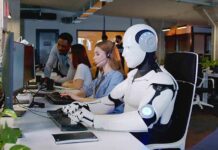


Japan is spending roughly $6 billion to build its own AI model and put 10 million AI-powered robots to work — a national push to stop depending on foreign technology.
Story Snapshot
- About 30 Japanese companies, including SoftBank, Sony, NEC, and Honda, formed a joint venture in April 2026 to build a homegrown AI model.
- The group is targeting a 1-trillion-parameter AI foundation model, with full operations expected as soon as 2027.
- Japan plans to deploy 10 million AI-equipped robots across 18 industries by 2040.
- The move is part of Japan’s broader goal to become the world’s most AI-friendly country and reduce reliance on U.S. and Chinese tech.
Japan’s Big Bet on Homegrown AI
On April 13, 2026, SoftBank, NEC, Sony Group, and Honda formally launched a new joint venture to build a Japanese AI foundation model. The venture aims to create a 1-trillion-parameter model — meaning an AI system trained on an enormous scale — designed specifically for what the group calls “physical AI.” That means AI built to run real-world machines, not just answer questions on a screen. Sony and NEC will lead the AI development side, while Honda and Sony will plug the finished models into robots and factory systems.
Around 30 Japanese companies have joined the effort. Reports put the total investment at roughly $6 billion, though no official government budget document has been published to confirm that exact figure. The consortium’s goal is to give Japanese businesses a domestic AI platform they can build on — rather than routing everything through American or Chinese systems. The group is targeting full operations as soon as 2027.
Robots in Every Corner of the Economy
Japan’s ambitions go well beyond software. The country wants 10 million AI-equipped robots working across 18 sectors by 2040. Those sectors include restaurants, food manufacturing, medicine, and other industries that struggle to find workers. Japan faces one of the steepest demographic cliffs in the world — an aging population and a shrinking workforce. Robots running on homegrown AI are seen as a practical fix, not just a tech showcase.
A Tokyo-based startup called Sakana AI also launched a system called “Fugu” in June 2026. Its top offering, Fugu Ultra, is being compared to leading foreign AI models in early tests. That kind of domestic competition signals Japan is not waiting for one big government project to carry the whole load. Private companies are moving fast on their own, giving the broader national effort more depth and resilience.
Why This Matters Beyond Japan
The race for sovereign AI is heating up worldwide. Countries that control their own AI models control their own data, their own narratives, and their own economic future. Japan watched what happened when U.S. export rules disrupted access to foreign AI tools — and decided it could not afford to stay dependent. Japan passed its AI Promotion Act in May 2025, setting up a national AI Strategy Headquarters inside the Cabinet to coordinate the push. The law favors innovation over heavy regulation, a sharp contrast to the European Union’s approach.
Japan plans to develop a homegrown artificial intelligence model and have 10 million AI-equipped robots operating in more than a dozen sectors by 2040, the government has said.
Source: InsiderPaper pic.twitter.com/pUhth5Xhbp
— Professor Iratus Genium (@PGenium) July 2, 2026
History offers a cautionary note. Back in 1981, Japan spent $850 million — worth over $2 billion today — on its Fifth Generation Computer Project, which aimed to build machines that could reason and translate languages. It fell short of its goals. This new effort is far larger, involves more private-sector firepower, and benefits from AI tools that simply did not exist in the 1980s. Still, the lesson holds: big national tech bets require tight coordination between money, data, and computing power to actually deliver. Whether Japan has learned that lesson will become clear by 2027.
Sources:
insiderpaper.com, channelnewsasia.com, finimize.com, x.com, tech-insider.org, linkedin.com, arxiv.org