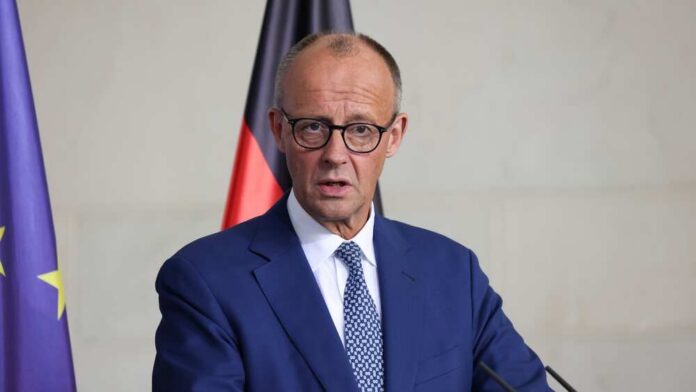
Germany’s new leadership is positioning Berlin as the nerve center of Ukraine peace talks—raising hard questions about who sets the terms, who pays, and how long the West can stay unified.
Story Snapshot
- Chancellor Friedrich Merz hosted President Volodymyr Zelenskyy in Berlin for high-level talks focused on peace negotiations, military assistance, and European security coordination.
- German and Ukrainian officials framed any ceasefire as requiring firm legal and material security guarantees backed by the U.S. and Europe.
- Zelenskyy stressed Ukraine must decide any territorial concessions, while Germany signaled negotiations may start from current contact lines.
- Berlin’s role as a diplomatic hub highlights a broader Western push to coordinate policy as war costs, voter fatigue, and internal politics pressure allied unity.
Berlin’s Diplomatic Push Signals a More Central German Role
German Chancellor Friedrich Merz met Ukrainian President Volodymyr Zelenskyy in Berlin as part of an intensified diplomatic track aimed at coordinating peace negotiations, military support, and long-term European security planning. The most recently documented round occurred in December 2025, following earlier talks in August 2025. Official readouts emphasized coordination with U.S. negotiators and European partners, signaling that Germany is trying to anchor a unified Western position rather than leaving Ukraine’s future to fragmented national agendas.
German government messaging after the talks presented the moment as an opportunity to move toward a “genuine peace process,” but with clear conditions. Merz argued that any ceasefire must be credible and enforceable, built on substantial legal and material guarantees from the United States and Europeans. That framing matters because it defines “peace” not as a quick paper deal, but as a structured security arrangement—something that typically requires funding commitments, weapons pipelines, and political buy-in across multiple capitals.
Security Guarantees and Air Defense Remain the Practical Center of Gravity
Ukrainian and German statements underscored that security guarantees are not an abstract diplomatic talking point; they link directly to near-term battlefield realities and deterrence after any ceasefire. The Ukrainian presidential office described continued strengthening of Ukraine’s defense capability, including additional Patriot air-defense systems and missiles. For taxpayers on both sides of the Atlantic, that emphasis points to a familiar tradeoff: guaranteeing stability may require years of sustained spending, while failing to deter renewed aggression could make future costs even higher.
The same dynamic also explains why allied leaders continue talking about sanctions and enforcement. German statements referenced maintaining pressure on Russia and European work on further sanctions, including measures aimed at evasive shipping networks. Whether sanctions meaningfully change Kremlin behavior is debated, but Berlin’s posture suggests leaders see economic pressure as a necessary companion to military aid. The public takeaway is straightforward: the coalition is trying to keep leverage while negotiating, not offer concessions up front.
Territory, Contact Lines, and the Risk of a “Freeze” That Becomes Permanent
Zelenskyy publicly emphasized that decisions about any seeding—or not seeding—of territory to Russia must remain with Ukrainians. At the same time, German messaging referenced current contact lines as a baseline for talks, a phrase that can be read as pragmatic—or as the start of a long, politically explosive debate about what “ending the war” means in practice. For Western democracies, territorial outcomes matter because they shape precedents for border changes by force and the credibility of deterrence.
Here, the available information has limits. The research indicates confidential talks occurred with U.S. negotiators and other European leaders, but it does not disclose detailed negotiation parameters or red lines. That secrecy is normal in diplomacy, yet it also fuels suspicion across the political spectrum—especially among voters already convinced that elites cut deals behind closed doors. The most defensible conclusion from the sources is that Berlin is organizing alignment, not announcing a settled endgame.
Why This Matters to Americans Watching from Trump’s Second Term
From a U.S. perspective in 2026, the Merz-Zelenskyy meetings matter because they reflect an effort to keep Europe more coordinated—and potentially more responsible—for its own regional security. Conservatives who prioritize burden-sharing will notice Germany publicly tying peace to enforceable guarantees and capability, not slogans. Skeptics will also note that guarantees can become open-ended obligations if objectives are unclear. Either way, the Berlin track signals that Europe is positioning itself to shape negotiations alongside Washington, not merely react to it.
LIVE: Chancellor Merz meets Ukraine’s Zelenskyy in Germany #AssociatedPress https://t.co/AolfAzQTFk
— #TuckFrump (@realTuckFrumper) April 14, 2026
Domestic politics still loom over every summit photo. Many Americans—right and left—believe government insiders protect their own interests first, then sell the public on whatever package emerges. The documented facts here show heavy coordination among governments, NATO-linked planning, and sanctions enforcement, all of which can be necessary in wartime. But the lack of disclosed details means accountability will depend on what leaders ultimately put in writing: the scope of security guarantees, the costs, the timeline, and the exact definition of “peace.”
Sources:
Press statement: Merz meets Zelenskyy
In Berlin, a meeting took place between Volodymyr Zelenskyy and Friedrich Merz