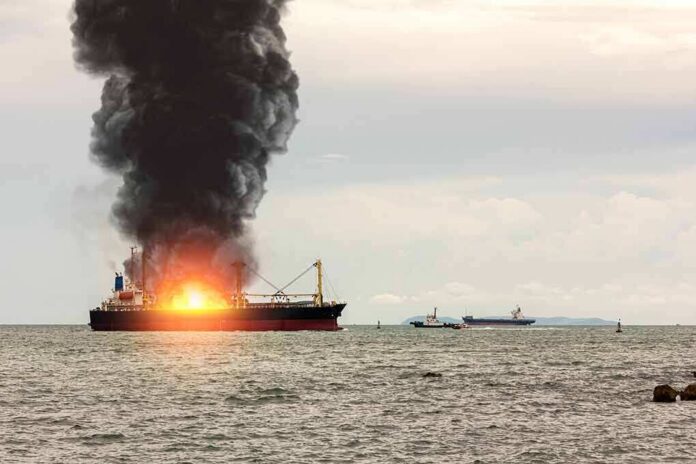
U.S. forces disabled a Curaçao-flagged tanker headed toward Iran’s Kharg Island after the ship ignored multiple warnings, according to U.S. Central Command statements reported by major outlets.
Story Highlights
- CENTCOM said an aircraft fired a Hellfire missile into the Belma’s smokestack after warnings.
- Reuters, Bloomberg, and NPR reported the tanker was unladen and transiting international waters toward Kharg.
- Iranian officials claimed the same vessel was hit again near or at Kharg Island, naming Belma.
- Conflicting accounts focus on location and timing, but agree U.S. forces disabled the ship.
What CENTCOM Says Happened
U.S. Central Command said forces observed the commercial tanker Belma transiting international waters toward Kharg Island and that the ship ignored multiple warnings before it was disabled. CENTCOM’s account, carried by BBC and NPR, said a U.S. aircraft fired a Hellfire missile into the ship’s smokestack, stopping it without sinking it. Bloomberg reported the vessel was unladen and described as U.S.-sanctioned, reinforcing that the target was a specific ship under scrutiny, not a random freighter.
Reuters’ and People’s Daily’s English edition also relayed that the strike occurred while the tanker headed toward Kharg Island, aligning with a blockade enforcement narrative. These reports stressed that the ship received warnings and failed to comply before the disabling shot. The description of a precision hit on the smokestack or engine area points to a goal of stopping movement, not causing mass casualties or a spill, which is consistent with interdiction tactics in busy waters.
What Iran-Linked Sources Claim
Iran International, citing a deputy governor in Bushehr, said an empty tanker docked at Kharg Island was hit again by U.S. missiles and identified the vessel as Belma. Middle East Eye, quoting the same official via Fars, said the “empty, Belma N.I.22” was attacked two days after an earlier hit, suggesting repeat action against the same hull. These claims dispute the location and timing, shifting the scene from international waters en route to Kharg to a strike on or near the island itself.
Reuters separately reported explosions heard near Kharg Island, while noting the origin was uncertain in the initial Iranian account. That aligns with wartime fog, where soundings and blasts are reported before full details emerge. None of the cited Iranian reports included an International Maritime Organization number or independent survey, which leaves gaps on ownership and exact position. The overlapping names—Belma and Belma N.I.22—also need registry confirmation to prove they are the same ship.
Why This Matters for U.S. Interests
Kharg Island is Iran’s key oil export hub. Stopping a non-compliant tanker before it docks strikes at the core of Iran’s oil lifeline without leveling terminals. CENTCOM’s messaging describes a measured action after warnings, which fits lawful blockade enforcement when a vessel attempts to break it. That approach protects U.S. and allied shipping, deters Iran’s game of brinkmanship in the Strait, and avoids needless risk to crews and the environment while still applying real pressure.
Reuters reports that an Iranian oil tanker near Kharg Island, Iran’s key oil-export hub, was reportedly struck by four U.S. missiles. No casualties were reported, and the crew was being evacuated. The U.S. has not yet officially confirmed the strike. #NationalSecurity
— The Dragoon (@CatholicDragoon) September 5, 2026
Conservative readers should see the broader pattern: Tehran’s media arms try to recast interdictions as unprovoked “attacks,” while U.S. forces keep the pressure on the regime’s oil cash flow. The reports here converge on a key point: U.S. forces disabled a specific tanker tied to Iran’s export route after it ignored warnings. Disputed details about whether a second strike occurred at the pier remain unverified. Until registry data, surveys, or satellite images surface, that second-hit claim stays an allegation, not settled fact.
Sources:
npr.org, bbc.com, iranintl.com, reuters.com, nytimes.com, bloomberg.com, en.people.cn