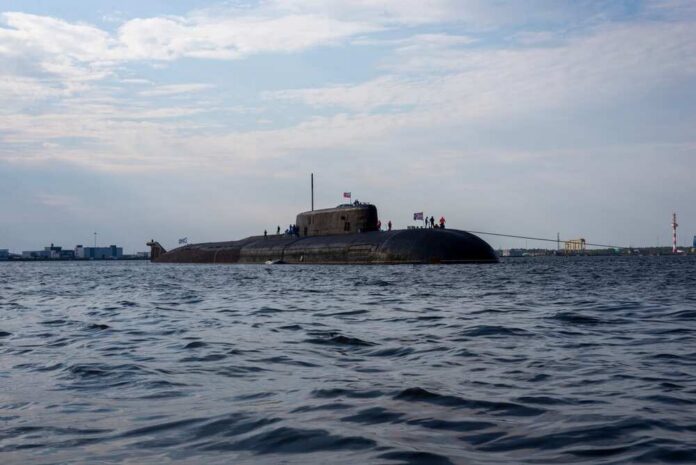
Russia’s Oscar II-class submarines, dubbed “Sledgehammers,” stand ready in 2026 to unleash devastating missile barrages against American aircraft carriers, posing a direct threat to U.S. naval dominance under President Trump’s renewed focus on military strength.
Story Highlights
- Russian Navy’s Oscar II submarines carry 24 long-range supersonic missiles designed specifically to sink NATO carriers through coordinated salvos.
- Ongoing 949AM modernization upgrades missile capacity to 72 rounds, including hypersonic Zircon weapons, despite sanctions.
- These subs integrate with advanced targeting networks, enabling standoff attacks that challenge U.S. carrier battle groups.
- Double-hull design and 30-knot submerged speed provide survivability and endurance for operations far from Russian shores.
- Eight operational Oscar II subs signal Moscow’s commitment to asymmetric naval power projection against American interests.
Cold War Origins Target U.S. Carriers
Soviet naval strategists developed the Oscar-class in the 1970s-1980s to counter U.S. Navy carrier-centric forces. Project 949 Oscar I established a missile-heavy platform for extended-range strikes. The Oscar II variant lengthened the hull by 10 meters, refined control surfaces, and improved quieting while retaining double-hull architecture. This 3.5-meter hull separation boosts buoyancy and torpedo resistance. Russia continues this legacy to project power against American naval superiority.
Asymmetric Design Overwhelms Defenses
Oscar II submarines pack 24 P-700 Granit supersonic missiles in a massive magazine, optimized for carrier-group annihilation rather than general combat. Integrated with the Legenda network of aircraft, satellites, and pickets, these subs receive real-time targeting data. Missiles cooperate in salvos: some climb as scouts, others skim seas and jam defenses, taxing Aegis systems. Submerged speed hits 30 knots with months-long endurance, keeping threats persistent in distant waters.
949AM Modernization Boosts Lethality
Project 949AM refits transform Oscar II into multi-mission platforms at Zvezda and Zvezdochka shipyards. Original 24 Granit tubes yield to modular launchers holding 72 mixed rounds of Kalibr, Oniks, and potential Zircon hypersonics. Upgrades include modern sonar, combat systems, and Liana targeting networks replacing Legenda. Two subs per Pacific and Northern fleets undergo work, though delays from sanctions and budgets persist. Eight hulls remain active.
Strategic Threat to American Interests
Oscar II forced NATO to expand carrier defenses and anti-submarine tactics, altering operational calculus in contested seas. Modernization dramatically expands flexibility for land-attack and anti-sub roles, sustaining Russian deterrence despite economic pressures. President Trump’s administration must prioritize countermeasures to protect carrier strike groups vital for projecting U.S. power and deterring aggressors like Russia. Limited data on exact timelines underscores need for vigilance.
Sources:
Naval Technology: Oscar Submarine Specifications
National Security Journal: Russia’s Oscar-Class Submarine Analysis
Nuclear Threat Initiative: Russia Submarine Capabilities
Covert Shores: Oscar II SSGN Technical Analysis