
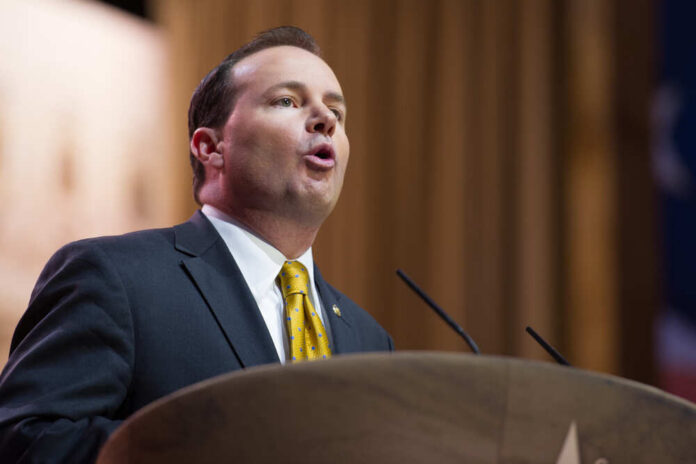
Sen. Mike Lee is trying to force Senate Democrats to physically hold the floor—on camera—if they want to block a vote requiring proof of citizenship in federal elections.
Quick Take
- Sen. Mike Lee is pushing a “talking filibuster” approach to get the SAVE America Act to a vote despite expected Democratic obstruction.
- Senate Majority Leader John Thune has said he wants to bring the bill up “when we can,” but also says there aren’t votes to change filibuster rules.
- Rep. Anna Paulina Luna said the White House offered “assurances” on scheduling a vote during spending negotiations, though leadership disputes any firm commitment.
- Democrats, led by Sen. Chuck Schumer, are openly vowing to fight the bill, framing it as restrictive; Republicans frame it as basic election integrity.
Lee’s Strategy: Make Obstruction Cost Time and Visibility
Sen. Mike Lee’s SAVE America Act would establish proof-of-citizenship requirements for federal elections, and it has built a sizable GOP coalition with more than 50 co-sponsors. The legislative problem is procedural: with a 53-seat Republican majority, the Senate still typically needs 60 votes to end debate and move to passage. Lee’s answer is reviving a “talking filibuster” model that pressures opponents to show up and speak continuously rather than quietly sustaining a blockade.
Supporters describe this as a return to an older Senate reality—if you want to stop a vote, you should have to hold the floor. Critics inside the GOP worry that any tweak labeled “filibuster reform” becomes a precedent that can later be used against conservatives when the majority flips. That tension matters because Lee is not only fighting Democrats; he is also trying to convince cautious Republicans that visibility and accountability are not the same thing as eliminating minority protections.
Thune’s Mixed Signals Highlight a Procedural Roadblock
Majority Leader John Thune has offered two messages that don’t easily align. Thune has said he intends to bring the SAVE America Act to the floor “whenever we can work it in,” signaling the bill remains on the majority’s agenda. At the same time, he has argued there are “not even close” to enough Republican votes to modify filibuster procedures, and he has suggested the talking-filibuster idea “doesn’t have a future.” Those statements point to a leadership concern: procedure fights can consume floor time and divide the conference.
That split—support for the bill versus reluctance to alter Senate mechanics—explains why conservatives keep hearing about “progress” without seeing a scheduled vote. Backers can claim momentum because the bill’s substance has significant support, but the math of the chamber still empowers unified Democratic resistance under cloture. The practical question is whether Republicans can pressure Democrats into a public, time-consuming filibuster without formally changing Senate rules—an outcome that would test whether today’s leadership will spend political capital to make the blockade harder to maintain.
The White House, Luna, and the “Assurances” Dispute
The White House is also part of the story, because Republican voters expect President Trump’s team to prioritize election integrity after years of public distrust and administrative chaos. Rep. Anna Paulina Luna injected new heat into the debate by saying the White House gave “assurances” that a vote would be scheduled on Lee’s bill as part of negotiations tied to a major government spending package. Luna later indicated the concept might be a “workaround,” not a formal removal of the filibuster, which suggests the promise—if real—was about calendar time, not rule changes.
Thune, however, has publicly insisted that decisions about alternative approaches were premature and that no commitments had been made. Based on the available reporting, that leaves a key limitation: the public cannot confirm whether “assurances” meant a firm plan, a general intention, or simple encouragement. What is clear is the political leverage dynamic—House conservatives can pressure Senate leaders through spending fights, while Senate leadership can resist procedural experiments by arguing they lack the votes and could destabilize the institution.
Democrats Signal Total Resistance as Murkowski Warns of Federal Overreach
Senate Democrats are not hiding their stance. Minority Leader Chuck Schumer has pledged to fight the SAVE America Act “tooth and nail,” and he has framed the bill as an attempt to disenfranchise Americans, particularly low-income voters and minorities. That sweeping charge is a messaging strategy, but it also telegraphs the reality of the Senate: if Democrats stay unified, the bill stalls under standard procedure. Republicans, meanwhile, argue the policy is a commonsense guardrail—citizens voting in American elections—rather than an ideological project.
One complicating factor is intra-party disagreement over the bill itself. Sen. Lisa Murkowski has warned the SAVE America Act would “federalize elections” and amount to federal overreach, raising concerns about imposing new national requirements on state election systems. Her critique highlights a conservative fault line between prioritizing election uniformity at the federal level and defending state administration of elections. If even a small number of Republicans share Murkowski’s view, the push to pair the bill with aggressive procedural tactics becomes harder to justify and harder to pass.
What to Watch Next: A Vote, a Standoff, or Another Delay
The next measurable sign of “major progress” is not a headline—it is a floor schedule, a motion, and a real test of whether Democrats will physically hold the Senate to block a citizenship-verification vote. Lee has acknowledged the effort is an uphill battle, and Thune’s public skepticism suggests leadership will not move until it sees internal unity. Until then, the SAVE America Act sits at the center of a broader constitutional argument: election rules should protect lawful votes while limiting Washington’s temptation to expand power without clear authority.
Sen. Mike Lee Reveals MAJOR Progress on SAVE America Act After Pressure on RINO Thune — HYBRID “Talking Filibuster” Set to Be Implemented https://t.co/mGco9fDgsO #gatewaypundit via @gatewaypundit
— Don Hum (@DonHum3) March 14, 2026
Sources:
Mike Lee wants a vote on the SAVE Act. Here’s how he might get one.
What is the SAVE Act? Mike Lee’s voter eligibility bill sparks Senate fight
Mike Lee discusses SAVE Act and Senate filibuster fight (video)