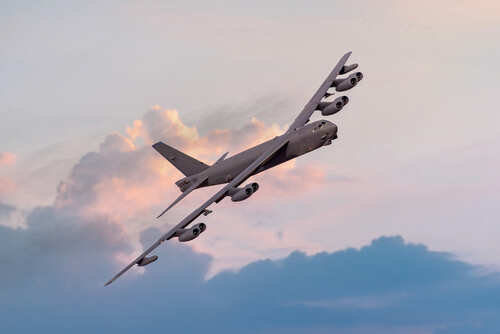
The Air Force just awarded Boeing a massive $2 billion contract to breathe new life into America’s legendary B-52 bombers, ensuring these strategic workhorses will dominate the skies for another century.
Story Highlights
- Boeing receives $2.04 billion contract to modernize two B-52H test aircraft with new Rolls-Royce F130 engines
- Historic bomber fleet will serve until 2060s, achieving an unprecedented 100 years of military service
- Contract part of $48.6 billion modernization program transforming 76 aircraft into advanced B-52J variants
- Testing phase runs through 2033, with production decision expected by 2028
Strategic Investment Secures America’s Nuclear Deterrent
The December 23, 2025 contract award represents a pivotal milestone in maintaining America’s strategic bomber superiority. Boeing will modify and test two B-52H Stratofortress bombers under the Commercial Engine Replacement Program, replacing aging 1960s-era Pratt & Whitney TF33 engines with modern Rolls-Royce F130 powerplants. This critical upgrade addresses reliability and fuel efficiency concerns that have plagued the six-decade-old fleet, ensuring our nuclear deterrent remains credible against rising global threats.
The program spans multiple defense facilities across Oklahoma City, San Antonio, Seattle, and Indianapolis, creating American jobs while strengthening our defense industrial base. Initial funding of approximately $36 million has been released immediately, with the remainder distributed incrementally through 2033. This measured approach reflects sound fiscal management while maintaining program momentum.
Watch:
Century-Long Service Extends Strategic Advantage
The B-52H first flew in 1962, and this modernization will extend its service life into the 2050s-2060s, achieving an remarkable century of operational capability. The upgraded aircraft will be redesignated as B-52J variants, featuring enhanced avionics, communications systems, digital displays, and new weapons integration alongside the engine replacement. This transformation occurs as the Air Force plans to retire less reliable B-1 and B-2 bombers while integrating with the new B-21 Raider fleet.
Expert analysis confirms the program’s strategic importance. Defense journalist Stephen Losey notes this represents a “major step forward for the overhaul into at least the 2050s, perhaps 2060.” The longevity approach proves more cost-effective than developing entirely new airframes while maintaining America’s bomber fleet superiority. This decision demonstrates prudent stewardship of taxpayer resources while preserving essential defense capabilities.
The upgrades to the B-52's engines and numerous other systems are so dramatic the Air Force plans to redesignate the Cold War-era bomber the B-52J. https://t.co/ZvDtVM13ks
— Defense News (@defense_news) January 6, 2026
Proven Track Record Overcomes Technical Challenges
The contract award follows successful completion of critical design reviews in December 2024, validating Rolls-Royce’s F130 engine integration after overcoming initial nacelle, auxiliary systems, and inlet challenges. Boeing’s selection as prime integrator builds on their decades of B-52 sustainment experience, while Rolls-Royce has invested over $600 million in Indianapolis manufacturing facilities to produce 600+ engines for the fleet.
Testing will commence at Edwards Air Force Base in 2026, with both engine and radar systems undergoing comprehensive evaluation. The program has maintained steady progress despite minor delays, with GAO oversight confirming the 2028 production decision timeline remains achievable. This methodical approach ensures thorough validation before fleet-wide implementation, protecting taxpayer investment while guaranteeing operational reliability.
Sources:
Boeing B-52 Port San Antonio Pentagon $2B Contract
US Air Force Awards Boeing $2B Contract to Begin B-52 Engine Upgrades
Boeing Secures $2bn Contract to Continue Work on B-52 Re-engining
Air Force $2 Billion Deal Re-Engine B-52s Testing