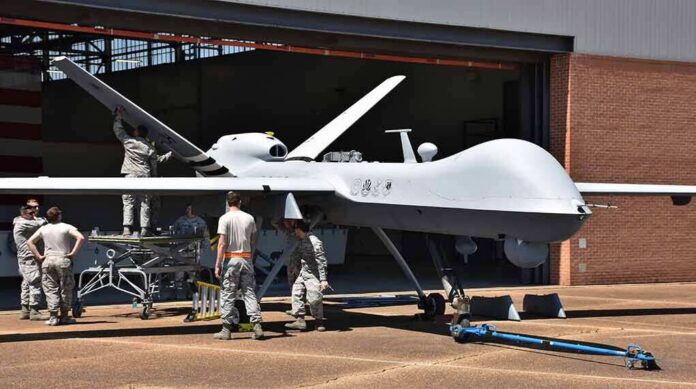
The Air Force is putting its new collaborative combat drones through real deployment drills, and that matters because the tests are moving from the factory to the fight.
Quick Take
- The Air Force’s Collaborative Combat Aircraft Experimental Operations Unit is holding an Agile Combat Employment exercise at Creech Air Force Base from July 20 to July 24.
- The drill includes end-to-end ground and flight operations for both the YFQ-42 and YFQ-44 prototypes.
- Officials say the goal is to test lean support, austere operations, and human-machine teaming in realistic conditions.
- The exercise comes after earlier ground testing, flight testing, and weapons trials for the program.
Air Force Moves CCA Testing Into a Field Exercise
Air Force-linked reporting says the Collaborative Combat Aircraft Experimental Operations Unit is running an Agile Combat Employment exercise at Creech Air Force Base in Nevada. The event runs from July 20 to July 24 and includes both the YFQ-42 and YFQ-44 prototypes. Military operators are leading ground and flight work to build tactics, test lean sustainment, and refine human-machine teaming.
The setting matters because Agile Combat Employment is built around moving forces, reducing the logistics footprint, and keeping combat power alive in harder conditions. That doctrine focuses on posture, command and control, movement, protection, and sustainment. For readers who want hard facts instead of slogans, this is the kind of trial that shows whether the program can leave the runway and keep working when support is limited.
Why the Creech Drill Signals a Bigger Shift
The CCA program has already moved through ground testing and developmental flight work before this field exercise. One report said the YFQ-44A completed a live air-to-air missile firing on July 15, which marked the first live-fire weapons employment for the program. That sequence shows a steady climb from prototype status toward combat use, not a paper exercise.
The Air Force has also said the broader CCA effort is meant to test, develop, and field autonomous aircraft that can work with crewed fighters. Open reporting on the program says both prototypes are already flying, and production awards followed in June 2026. For supporters of a strong military and a leaner defense structure, that is a welcome sign that the service is trying to add combat mass without adding another bloated manned fleet.
What the Public Still Does Not Know
Even with these visible milestones, the service is still limiting some details for operational security. That is common in military testing, where the public sees the exercise but not every metric, routing choice, or support method. Earlier Air Force and outside reporting also shows the program has been shaped by classified or restricted test plans, which leaves outsiders with only the pieces the service chooses to show.
Fury Loyal Wingman Arrives At Creech AFB For Agile Combat Deployment Trials
Both of the USAF's CCAs, the YFQ-44 Fury and YFQ-42 Dark Merlin, are to be put through their paces at Creech AFB in Southern Nevada.
Anduril’s YFQ-44 Fury Collaborative Combat Aircraft (CCA) caught the… pic.twitter.com/FP6eVTxnZX— Dee Knight (@DeeKnig67666008) July 22, 2026
There is also a wider strategic angle here. The CCA concept is meant to give the Air Force more mass, more reach, and more flexibility in contested airspace. If these drones can operate from austere locations and keep pace with fast-moving missions, they could become a force multiplier for fighter units and a sharp answer to China-focused planning.
Sources:
realcleardefense.com, twz.com, defense-update.com, airforce-technology.com, acc.af.mil, theaviationist.com, doctrine.af.mil, congress.gov, airandspaceforces.com, migflug.com