

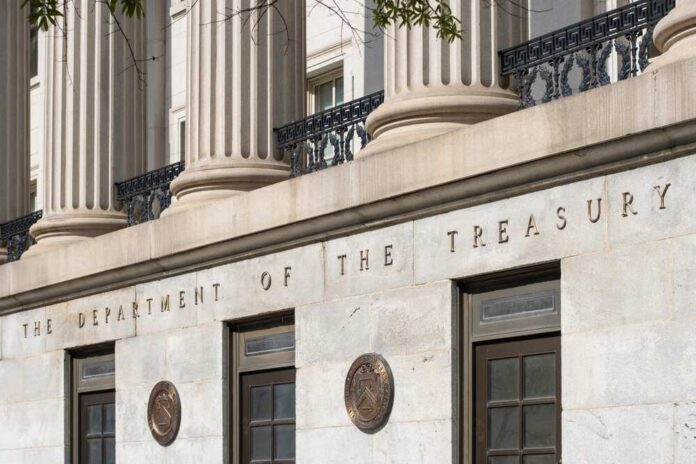
Hunter Biden’s latest push to frame Jeffrey Epstein as part of a hidden “class” only deepens the public distrust many Americans already feel toward elite power networks.
Quick Take
- Hunter Biden said his father was pushed aside by a Washington elite he described as the “Epstein Class.”
- He repeated claims that Jeffrey Epstein had unusual access to Treasury Department officials on cryptocurrency and sanctions issues.
- The available reporting points to alleged consultations and follow-up contacts, but not a documented policy decision driven by Epstein.
- The dispute remains centered on secondary reporting, not the underlying Treasury records or notes themselves.
What Hunter Biden Said About the “Epstein Class”
Hunter Biden made the remarks in an interview with conservative commentator Candace Owens, saying his father was not part of the “Epstein Class” and was treated as an outsider by the Washington establishment [1][3]. He also used the appearance to attack President Donald Trump and revisit old scandals surrounding the Biden family. For readers who have long suspected that the capital runs on insider privilege, the language lands like a blunt admission of how elites talk about themselves.
The interview matters because it does not stay inside family drama. The same discussion linked Epstein to government and financial power, including claims that Treasury officials once sought his help understanding cryptocurrency, Bitcoin, sanctions evasion, and illicit finance [1][2][4]. That is the kind of allegation that raises immediate questions about who had access to policymakers, why that access existed, and whether the public was ever supposed to know. The reporting says Epstein’s notes and follow-up contacts suggest more than a one-off conversation.
What the Reporting Actually Shows
The strongest public claim in the available material is that Treasury Department officials met with Epstein in August 2014 and wanted his insight on how digital currency could be used for arms shipments, nuclear proliferation payments, terrorism financing, and sanctions evasion [1]. The reporting also says Epstein’s notes memorialized the meeting, which would suggest contemporaneous documentation exists beyond later retellings [1]. That matters, because the question is not whether Epstein was a disgusting figure, but whether a federal department treated him as a source on sensitive policy.
The reporting further says Epstein helped arrange a later meeting between Treasury-connected officials and an Massachusetts Institute of Technology-linked figure named Ito, and that he encouraged the official to say he and Epstein “share one mind” on crypto regulation [1]. A separate interview transcript repeats the claim that Epstein was briefing Treasury on cryptocurrency and Bitcoin as a means of sanctions evasion and funding illicit activity [2]. Even so, the materials stop short of proving that Treasury adopted Epstein’s views or that his advice changed policy.
Why the Evidence Still Needs Hard Documentation
The record provided here is still mostly mediated through investigative reporting and commentary rather than original government files [1][2][4]. No Treasury press release, inspector general finding, or official document release appears in the supplied material to confirm the meeting in full detail. That leaves a familiar Washington problem: the public gets hints of backroom access, but not the visitor logs, calendar entries, internal emails, or authenticated notes needed to lock down exactly what happened. For conservative readers, that should sound like a transparency failure, not a finished case.
Epstein played a major role in shaping and funding crypto.
AI: Peter Thiel is extensively mentioned in the Jeffrey Epstein files. In tranches of documents released by the U.S. House Oversight Committee and the Department of Justice, his name appears over 2,200 times." 🤠
— Solar Timing (@TimingSolar) May 22, 2026
The most cautious reading is also the most responsible one. The reporting supports the claim that Epstein had unusual access and was discussed as a source on crypto and sanctions issues [1][2][4]. It does not, however, show a policy outcome, a formal advisory role, or proof that his suggestions were adopted [1][2]. Until the underlying records are released, the public is left with a troubling but incomplete picture: elite contact, possible influence, and a lot of unanswered questions about how far the rot inside Washington really went.
Sources:
[1] Web – Epstein Advised U.S. Treasury on Crypto During Obama’s Iran …
[2] YouTube – U.S. Treasury Consulted Epstein on Crypto During Obama-Era Iran …
[3] Web – New release sheds light on Epstein’s ties to presidents, business …
[4] Web – Jeffrey Epstein, Treasury Officials, and the Early Cryptocurrency …